
AWS Security Cards: Free Offensive Security Reference for 60 AWS Services
Tarek Cheikh
Founder & AWS Cloud Architect
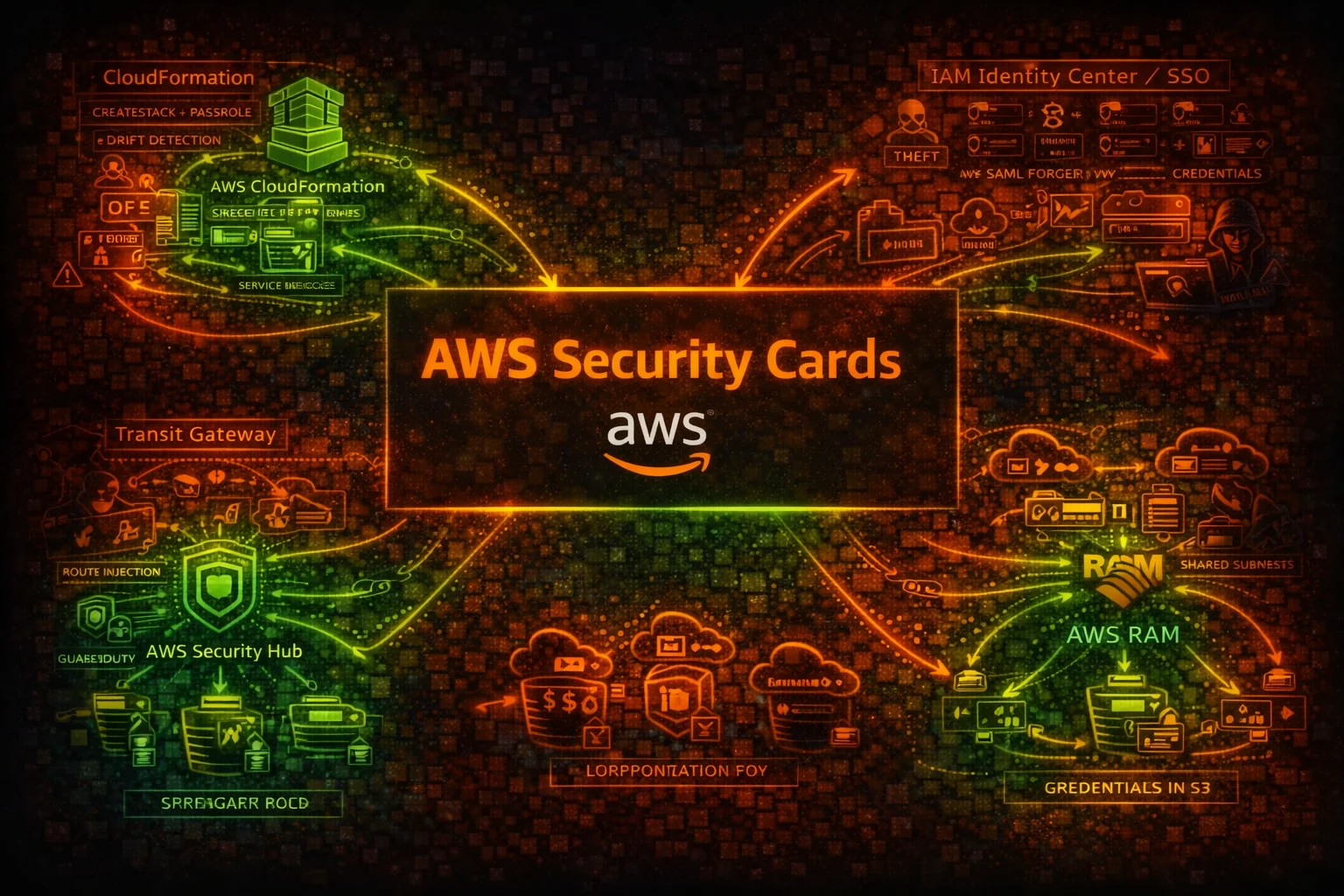
AWS documentation tells you how services work. It doesn't tell you how they break.
AWS Security Cards: fills that gap. It's a free, open-source set of security reference cards: one per AWS service, 60 total, covering attack vectors, misconfigurations, enumeration commands, privilege escalation, persistence, detection, and defense. Available in Markdown, HTML, and PDF.
What's in a card
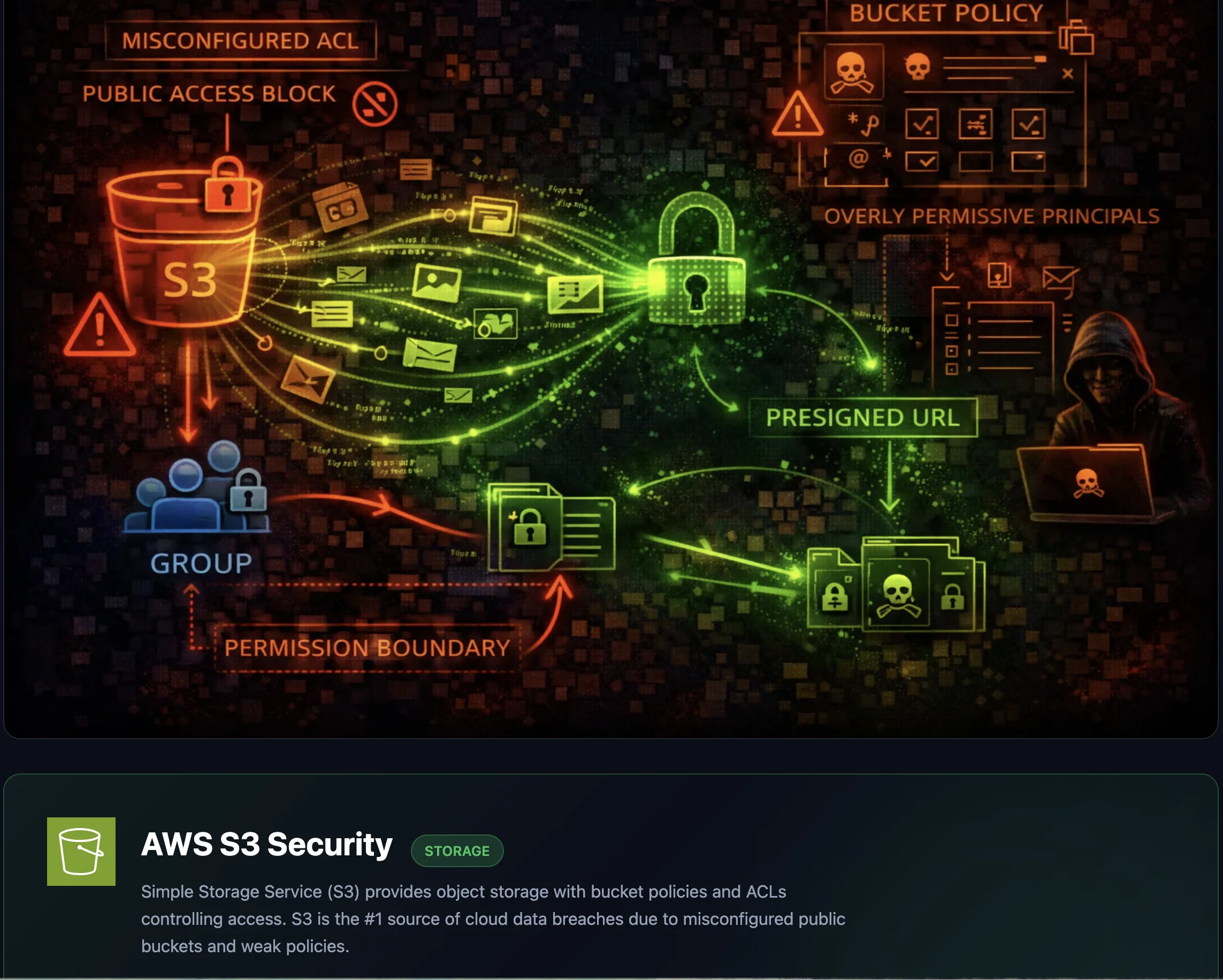
Each card covers a single AWS service from an offensive and defensive security perspective:
- Service overview: with attacker-relevant context
- Attack vectors: concrete exploitation paths, not vague risk statements
- Common misconfigurations: what actually leads to breaches
- Enumeration commands: copy-paste AWS CLI for security assessments
- Privilege escalation: how read access becomes admin
- Persistence techniques: how access survives incident response
- Detection indicators: what shows up in CloudTrail and monitoring
- Policy examples: good vs. bad IAM/resource policies, side by side
- Defense recommendations: hardening commands you can run today
- Risk score: from 5.5 to 9.5, to help prioritize
Risk scores across the board
| Risk | Services |
|---|---|
| 9.5 | IAM, STS, Organizations, Secrets Manager, Identity Center |
| 9.0-9.2 | Redshift, EC2, S3, EKS, RDS, CodeBuild, CloudFormation, Route 53, Backup, Glue, Directory Service |
| 8.5 | CloudTrail, API Gateway, ECR, ECS, OpenSearch, Systems Manager, SageMaker, Step Functions, Security Hub, Transit Gateway |
| 7.0-8.0 | DynamoDB, Cognito, KMS, EBS, AppSync, Athena, EventBridge, RAM, VPC, GuardDuty, and more |
| < 7.0 | App Runner, SQS, ELB, SNS, Amplify, Inspector, ACM, Network Firewall, WAF |
Some of these might surprise you. AWS Backup at 9.0, higher than Lambda. An attacker who gets into Backup can delete every recovery point in your account. Ransomware with no recovery path. CodeBuild at 9.0, one malicious buildspec exfiltrates every secret and poisons every artifact downstream.
A few things worth knowing
There are 20+ known privilege escalation paths through IAM alone. CreatePolicyVersion, PassRole, UpdateAssumeRolePolicy, AttachUserPolicy. Most AWS accounts have at least one of these unguarded.
Many persistence techniques don't produce obvious CloudTrail signals. A Lambda layer with a backdoor, an ECR image with a modified entrypoint, a trust policy added to a role. Standard alerting won't catch these unless you're specifically looking.
CI/CD is the new perimeter. ECR, CodeBuild, and CodePipeline are supply chain components. Compromise one, and everything that deploys through it is tainted.
Formats
Each card ships in three formats, all generated from the same source:
- Markdown: readable on GitHub, easy to search and contribute to
- HTML: standalone dark-themed pages, works offline in any browser
- PDF: print-ready, with embedded images and AWS service icons
Use cases
Print the PDFs for your next pentest. Use the enumeration commands during a security assessment. Hand the defense recommendations to your engineering team after an audit. Use the policy examples in a training session. Search the Markdown files when you need to quickly check a specific service.
Contribute
MIT licensed. If something is wrong or missing, open a PR.
Go Deeper: The State of AWS Security 2026
This article is just the start. Get the full picture with our free whitepaper - 8 chapters covering IAM, S3, VPC, monitoring, agentic AI security, compliance, and a prioritized action plan with 50+ CLI commands.
Toc Consulting: AWS Security & Cloud Architecture
Want expert help with AWS Security?
Our team helps engineering teams secure and architect AWS the right way: assessment in week one, a prioritized action plan in week two.
More Articles
KloudSec Is Live. This Is My Fight for Every Company That Isn't a Giant.
KloudSec, an agentless AWS security platform, is live. Why I built it, and why small and growing companies deserve the same protection as the largest ones.
The Verdict, Four Months Later
Part 16 of 16 in the AWS Security Agent: From Zero to Hero series. Closing the series: the numbers this whole project is built on, the honest verdict distilled to its essentials, what AWS has shipped since my hands-on testing, and an evidence-based look at how AI pentesting stacks up against traditional consultancy today.
The Agent's AWS Footprint
Part 15 of 16 in the AWS Security Agent: From Zero to Hero series. What AWS Security Agent leaves behind in your own account. CloudTrail events, Secrets Manager entries, and VPC Flow Logs, with the commands to audit and observe every run yourself.