
AWS CloudFront Security
CDNAmazon CloudFront is a global CDN that delivers content with low latency. It sits in front of origins (S3, ALB, EC2, custom) and can be a critical security boundary for web applications.
📋Service Overview
Content Delivery
CloudFront caches and delivers content from edge locations worldwide. Supports static files, dynamic content, streaming, and WebSocket connections. Can serve as reverse proxy for APIs.
Origins: S3 buckets, ALB/ELB, EC2, Lambda@Edge, API Gateway, custom HTTP servers
Security Features
Integrates with WAF, Shield, ACM for DDoS protection and TLS. Supports signed URLs/cookies, geo-restriction, field-level encryption, and Origin Access Control (OAC).
Edge compute: Lambda@Edge and CloudFront Functions for request/response manipulation at edge locations
Security Risk Assessment
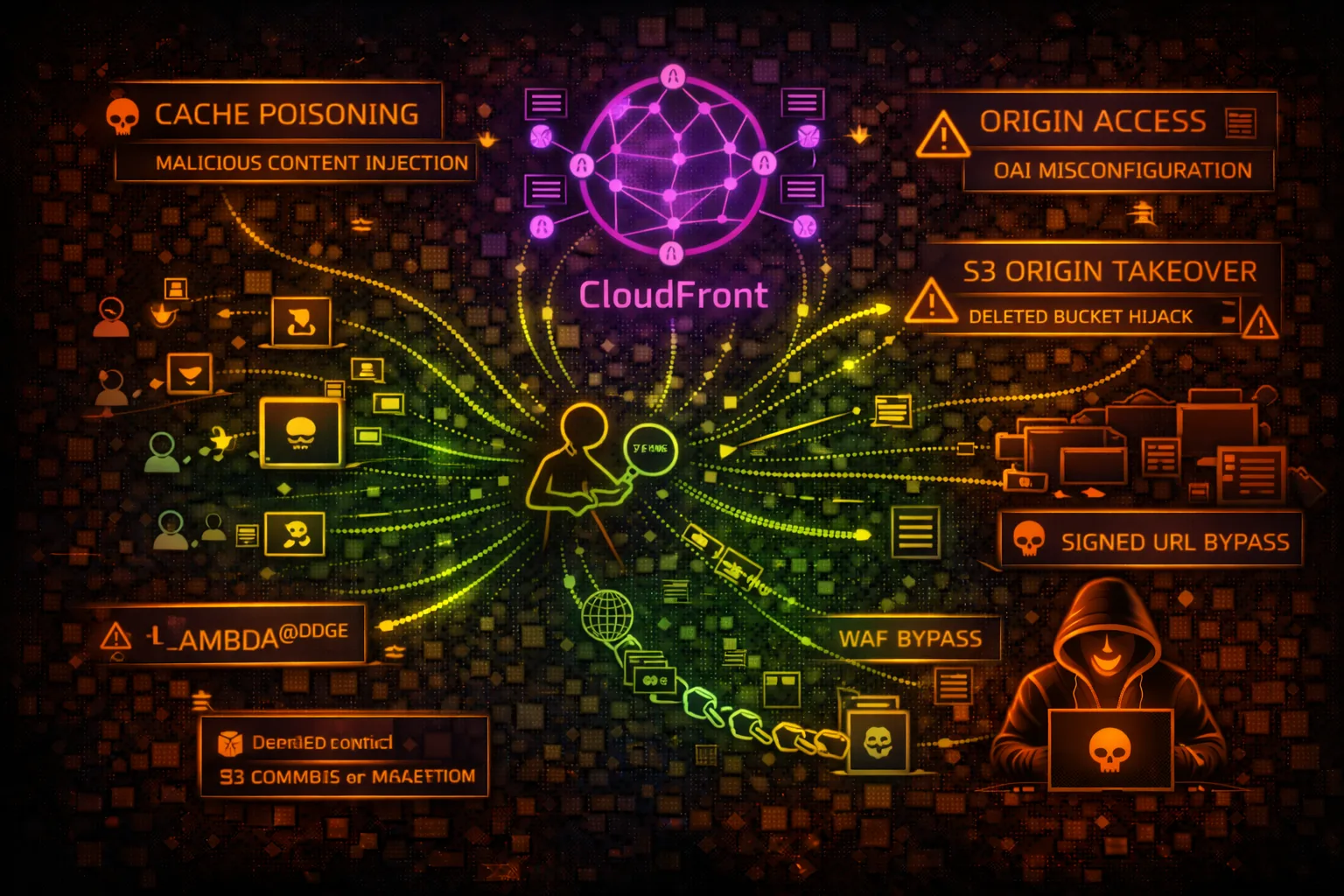
CloudFront misconfigurations can expose origin servers, bypass WAF rules, leak sensitive data via cache poisoning, and allow unauthorized access to private content. Origin takeover is a critical risk.
⚔️Attack Vectors
Origin Attacks
- •Origin server discovery and direct access
- •Subdomain takeover of S3 origin buckets
- •Custom origin without proper authentication
- •Origin header injection
- •HTTP request smuggling to origin
CDN Attacks
- •Cache poisoning via headers/parameters
- •Cache deception attacks
- •Signed URL/cookie bypass
- •Lambda@Edge code injection
- •Web cache deception for sensitive data
⚠️Misconfigurations
Distribution Misconfigs
- •Origin Access Control not configured
- •S3 bucket policy allows public access
- •No WAF association
- •TLS 1.0/1.1 still enabled
- •Permissive CORS headers cached
- •Caching sensitive endpoints
Origin Misconfigs
- •Origin directly accessible from internet
- •Missing origin authentication header
- •Unencrypted origin connection (HTTP)
- •Origin failover to insecure backup
- •Custom origin with weak TLS config
🔍Enumeration
aws cloudfront list-distributions --query 'DistributionList.Items[*].[Id,DomainName,Origins.Items[0].DomainName]'aws cloudfront get-distribution-config --id EXXXXXXXXXXaws cloudfront list-origin-access-controlsaws cloudfront get-cache-policy --id XXXXXXXX-XXXX-XXXX-XXXX-XXXXXXXXXXXXaws cloudfront list-functions💉Cache Attacks
Cache Poisoning
- •Inject malicious content via unkeyed headers
- •X-Forwarded-Host header injection
- •X-Original-URL for path manipulation
- •Parameter pollution to poison cache
- •Exploit vary header misconfigurations
Cache Deception
- •Append .css/.js to sensitive endpoints
- •/api/user/profile/logo.png caching trick
- •Path confusion with trailing characters
- •Response splitting via headers
- •Steal cached authenticated responses
Tip: Look for endpoints where static file extensions cause caching of dynamic content containing user data.
🎯Origin Takeover
S3 Origin Takeover
- •Origin bucket deleted but CF still points to it
- •Create bucket with same name in same region
- •Serve malicious content via CloudFront
- •Phishing pages on legitimate domain
- •Malware distribution via trusted CDN
Detection & Exploitation
- •Look for 404/403 with S3 error messages
- •Check if bucket name is available
- •Create bucket and upload test file
- •Verify content served via CloudFront
- •Report or exploit responsibly
🛡️Detection
CloudTrail Events
- •CreateDistribution - new distribution
- •UpdateDistribution - config changes
- •CreateOriginAccessControl - OAC changes
- •CreateFunction - edge function creation
- •DeleteDistribution - distribution removal
CloudFront Logs
- •Enable access logging to S3
- •Monitor cache hit/miss ratios
- •Watch for unusual origin requests
- •Track geographic access patterns
- •Alert on 4xx/5xx spike
💻Exploitation Commands
aws cloudfront list-distributions \
  --query "DistributionList.Items[?contains(Aliases.Items, 'target.com')].Id" \
--output textaws cloudfront get-distribution --id EXXXXXXXXXX \
--query "Distribution.DistributionConfig.Origins.Items[*].DomainName"curl -H "X-Forwarded-Host: evil.com" \
-H "X-Original-URL: /admin" \
https://target.cloudfront.net/page# If you see "NoSuchBucket" error
aws s3api head-bucket --bucket origin-bucket-name 2>&1 | grep -q "404" && echo "Takeover possible!"aws cloudfront create-invalidation \
--distribution-id EXXXXXXXXXX \
--paths "/*"aws cloudfront get-distribution --id EXXXXXXXXXX \
--query "Distribution.DistributionConfig.DefaultCacheBehavior.TrustedSigners"📜S3 Bucket Policy Examples (for CloudFront)
{
  "Version": "2012-10-17",
  "Statement": [{
    "Sid": "PublicRead",
    "Effect": "Allow",
    "Principal": "*",
    "Action": "s3:GetObject",
    "Resource": "arn:aws:s3:::my-bucket/*"
  }]
}
Bucket is publicly accessible - CloudFront provides no real protection
{
  "Version": "2012-10-17",
  "Statement": [{
    "Sid": "AllowCloudFrontOAC",
    "Effect": "Allow",
    "Principal": {
      "Service": "cloudfront.amazonaws.com"
    },
    "Action": "s3:GetObject",
    "Resource": "arn:aws:s3:::my-bucket/*",
    "Condition": {
      "StringEquals": {
        "AWS:SourceArn": "arn:aws:cloudfront::123456789012:distribution/EXXXXXXXXXX"
      }
    }
  }]
}
Only CloudFront can access origin via Origin Access Control
{
  "Version": "2012-10-17",
  "Statement": [{
    "Effect": "Allow",
    "Principal": {
      "AWS": "arn:aws:iam::cloudfront:user/CloudFront Origin Access Identity *"
    },
    "Action": "s3:GetObject",
    "Resource": "arn:aws:s3:::my-bucket/*"
  }]
}
Wildcard OAI allows any CloudFront distribution to access - use OAC instead
# CloudFront Custom Origin Config
Origin Custom Headers:
  X-Origin-Verify: super-secret-value-123

# Origin Server Validation
if request.headers['X-Origin-Verify'] != 'super-secret-value-123':
    return 403
Custom header validates requests came through CloudFront
🛡️Defense Recommendations
Use Origin Access Control
Replace legacy OAI with OAC for S3 origins. Provides better security with SigV4 signing.
aws cloudfront create-origin-access-control \
  --origin-access-control-config \
Name=MyOAC,SigningProtocol=sigv4,SigningBehavior=always,OriginAccessControlOriginType=s3Associate WAF WebACL
Protect against common web attacks with AWS WAF rules.
aws cloudfront update-distribution \
  --id EXXXXXXXXXX \
  --distribution-config file://config.json
# Add WebACLId to configEnforce HTTPS Only
Redirect HTTP to HTTPS and use TLS 1.2+ for origin connections.
ViewerProtocolPolicy: redirect-to-https
OriginProtocolPolicy: https-only
OriginSSLProtocols: [TLSv1.2]Enable Access Logging
Log all requests to S3 for security monitoring and incident response.
aws cloudfront update-distribution \
  --id EXXXXXXXXXX \
--distribution-config '{"Logging":{"Enabled":true,"Bucket":"logs.s3.amazonaws.com","Prefix":"cf/"}}'Restrict Origin Access
Block direct access to origin by allowing only CloudFront IP ranges or using custom headers.
Use Signed URLs/Cookies
Protect private content with signed URLs or cookies using CloudFront key pairs.
# Generate signed URL
aws cloudfront sign \
  --url https://d111.cloudfront.net/private/file.pdf \
  --key-pair-id KXXXXXXXXXXXX \
  --private-key file://private_key.pem \
  --date-less-than 2024-12-31
AWS CloudFront Security Card • Toc Consulting
Always obtain proper authorization before testing
KloudSec, built by the team behind Toc Consulting
See AWS CloudFront security checked automatically, continuously
What you just read is a manual, one-time check. KloudSec runs this and 400+ more automated checks across 90+ AWS services, continuously, agentless, live in about 5 minutes.
Toc Consulting: AWS Security & Cloud Architecture
Securing your AWS estate?
Our team helps engineering teams secure and architect AWS the right way: assessment in week one, a prioritized action plan in week two.