
AWS CloudFormation Security
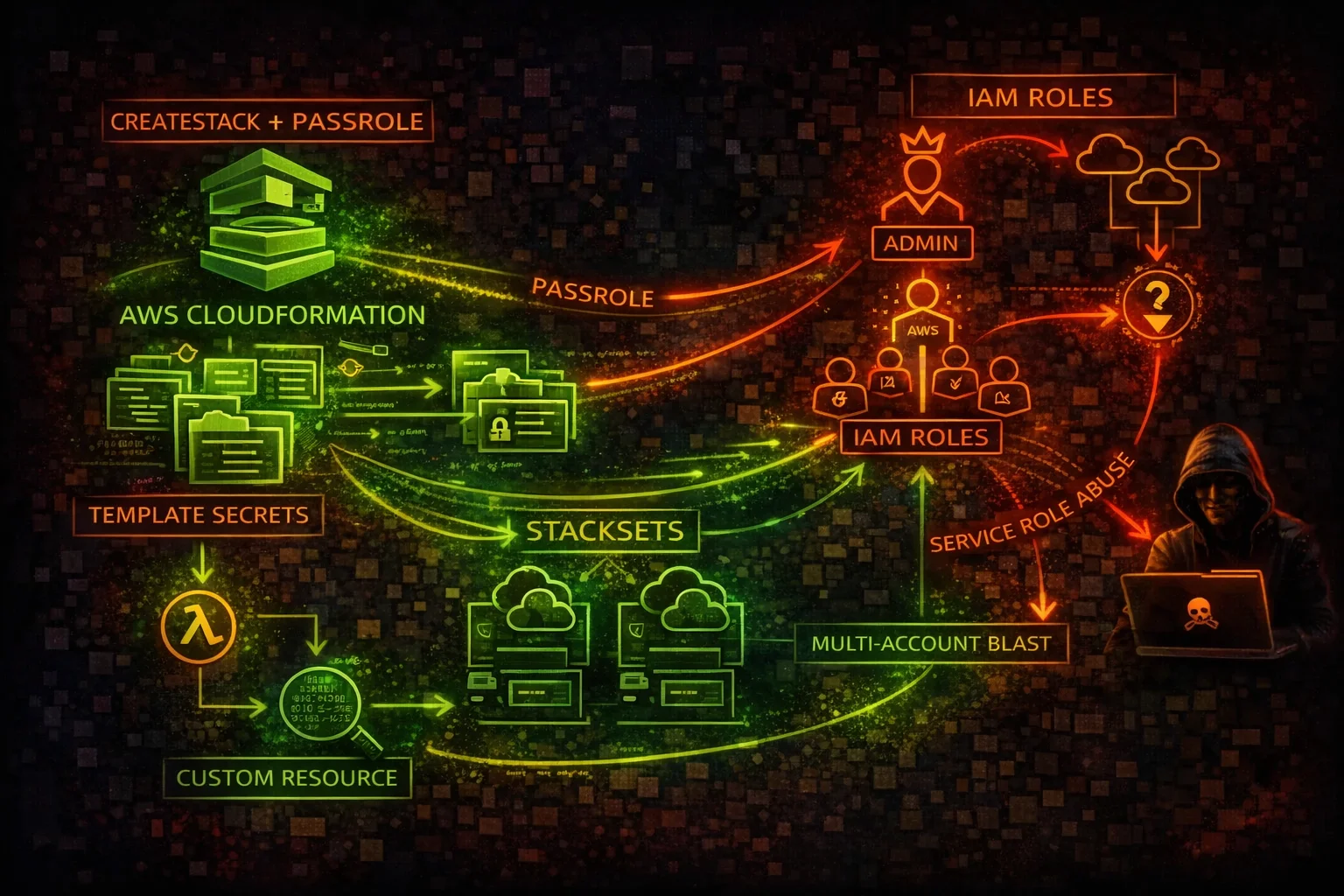
INFRASTRUCTURE AS CODECloudFormation provisions AWS resources via templates. Attackers abuse CreateStack with PassRole to escalate privileges, extract secrets from templates and outputs, and leverage Custom Resources for arbitrary code execution.
📋Service Overview
Stack & Template Model
CloudFormation uses JSON/YAML templates to declaratively provision AWS resources as stacks. Templates may contain hardcoded secrets, IAM policies, and infrastructure details that attackers can extract via GetTemplate.
Service Roles & PassRole
CloudFormation can assume a service role to create resources. If a user has iam:PassRole and cloudformation:CreateStack, they can pass an AdministratorAccess role and create any resource, effectively escalating to admin.
StackSets & Custom Resources
StackSets deploy stacks across multiple accounts and regions simultaneously. Custom Resources invoke Lambda functions or SNS topics during stack operations, enabling arbitrary code execution within the deployment pipeline.
Security Risk Assessment
CloudFormation with iam:PassRole is one of the most reliable privilege escalation paths in AWS. Templates leak secrets, StackSets amplify blast radius across accounts, and Custom Resources execute arbitrary code.
⚔️Attack Vectors
Privilege Escalation via PassRole
- •CreateStack + PassRole with admin service role = full admin
- •Service role with AdministratorAccess creates any resource
- •Create IAM users/roles/policies via stack templates
- •UpdateStack to modify existing infrastructure silently
- •StackSets to deploy backdoors across all org accounts
Secret Extraction
- •GetTemplate exposes hardcoded passwords and API keys
- •Stack Outputs leak database endpoints, credentials, ARNs
- •ListExports reveals cross-stack shared values
- •describe-stack-events shows parameter values in logs
- •Template stored in S3 may be publicly accessible
⚠️Misconfigurations
Service Role Issues
- •CloudFormation service role with AdministratorAccess
- •Service role shared across multiple stacks
- •No condition keys restricting CreateStack callers
- •PassRole allowed for any role (Resource: *)
- •Service roles never audited or rotated
Template & Stack Issues
- •Secrets hardcoded in template Parameters with NoEcho only
- •Drift detection not enabled or never run
- •Stack policy not configured (any resource can be updated)
- •Termination protection not enabled on critical stacks
- •Outputs exposing database passwords or API keys
🔍Enumeration
aws cloudformation describe-stacksaws cloudformation get-template \
--stack-name TargetStackaws cloudformation list-stack-resources \
--stack-name TargetStackaws cloudformation list-exportsaws cloudformation describe-stack-events \
--stack-name TargetStack🔓Privilege Escalation
CreateStack + PassRole Chain
- •iam:PassRole + cloudformation:CreateStack = admin escalation
- •Pass admin role to CFN, template creates backdoor IAM user
- •Template creates Lambda with admin role for persistent access
- •UpdateStack modifies existing resources with elevated role
- •Custom Resource Lambda executes code as the service role
StackSet Escalation
- •create-stack-set deploys to every account in the org
- •StackSet admin role trusts CloudFormation service globally
- •Execution role in target accounts often has AdministratorAccess
- •Single template change propagates across all member accounts
- •StackSet drift rarely monitored across org
⚡Persistence Techniques
Infrastructure Persistence
- •Deploy backdoor IAM user/role via stack template
- •Create Lambda with reverse shell as Custom Resource
- •Deploy EC2 instance with attacker SSH key via stack
- •Nested stacks hide malicious resources in child templates
- •Stack with DeletionPolicy: Retain keeps resources after delete
Template Tampering
- •Modify S3-hosted templates to inject resources on next update
- •Add Custom Resource that phones home on every stack operation
- •StackSet with auto-deploy creates resources in new accounts
- •CloudFormation macros transform templates at deploy time
- •Change Sets can be pre-staged for later execution
🛡️Detection
CloudTrail Events
- •CreateStack - new stack created with role
- •UpdateStack - stack template or params modified
- •CreateStackSet - multi-account deployment initiated
- •GetTemplate - template contents retrieved
- •SetStackPolicy - stack protection changed
Indicators of Compromise
- •Stack created with AdministratorAccess service role
- •GetTemplate calls from unusual principals
- •StackSet deployed to accounts outside normal pattern
- •Custom Resource Lambda created with broad permissions
- •Stack drift detected on IAM resources
💻Exploitation Commands
aws cloudformation create-stack \
  --stack-name privesc-stack \
  --template-body file://backdoor-template.yaml \
  --role-arn arn:aws:iam::ACCOUNT:role/CFNAdminRole \
--capabilities CAPABILITY_NAMED_IAMaws cloudformation get-template \
--stack-name ProductionStack \
--template-stage Originalaws cloudformation describe-stacks \
--query 'Stacks[].Outputs[].[OutputKey,OutputValue]' \
--output tableaws cloudformation create-stack \
--stack-name custom-res \
--template-body file://custom-resource.yaml \
--role-arn arn:aws:iam::ACCOUNT:role/CFNRole \
--capabilities CAPABILITY_IAMaws cloudformation create-stack-set \
--stack-set-name backdoor-stackset \
--template-body file://backdoor.yaml \
--permission-model SERVICE_MANAGED \
--auto-deployment Enabled=true,RetainStacksOnAccountRemoval=true \
--capabilities CAPABILITY_NAMED_IAMaws cloudformation list-exports \
--query 'Exports[].[Name,Value]' \
--output table📜CloudFormation Policy Examples
{
  "Version": "2012-10-17",
  "Statement": [{
    "Effect": "Allow",
    "Action": [
      "cloudformation:CreateStack",
      "cloudformation:UpdateStack",
      "iam:PassRole"
    ],
    "Resource": "*"
  }]
}
CreateStack + PassRole with no resource constraint allows passing AdministratorAccess role to CloudFormation for full privilege escalation
{
  "Version": "2012-10-17",
  "Statement": [{
    "Effect": "Allow",
    "Action": "iam:PassRole",
    "Resource": "arn:aws:iam::ACCOUNT:role/CFN-LimitedRole",
    "Condition": {
      "StringEquals": {
        "iam:PassedToService": "cloudformation.amazonaws.com"
      }
    }
  }]
}
PassRole restricted to a specific least-privilege role and only for CloudFormation service
{
  "Version": "2012-10-17",
  "Statement": [{
    "Effect": "Allow",
    "Action": "cloudformation:*",
    "Resource": "*"
  }]
}
Full access allows GetTemplate (secret extraction), CreateStackSet (multi-account compromise), and stack deletion
{
  "Version": "2012-10-17",
  "Statement": [{
    "Sid": "DenyCFNWithoutApprovedRole",
    "Effect": "Deny",
    "Action": [
      "cloudformation:CreateStack",
      "cloudformation:CreateStackSet"
    ],
    "Resource": "*",
    "Condition": {
      "StringNotEquals": {
        "cloudformation:RoleArn": [
          "arn:aws:iam::*:role/Approved-CFN-Role"
        ]
      }
    }
  }]
}
SCP enforces only approved service roles can be used with CloudFormation stack creation
🛡️Defense Recommendations
Least-Privilege Service Roles
Never use AdministratorAccess for CloudFormation service roles. Scope to only the resources the stack needs.
aws iam create-role --role-name CFN-LimitedRole \
  --assume-role-policy-document file://cfn-trust.json
# Trust: {"Service": "cloudformation.amazonaws.com"}SCP Restrict CreateStack
Use Organization SCPs to deny CreateStack unless a pre-approved service role is specified.
Enable Drift Detection
Run drift detection regularly to catch out-of-band changes to stack resources, especially IAM.
aws cloudformation detect-stack-drift \
--stack-name ProductionStackEnable Stack Policies
Prevent updates to critical resources like IAM roles and security groups within stacks.
aws cloudformation set-stack-policy --stack-name Prod \
--stack-policy-body '{"Statement":[{"Effect":"Deny","Action":"Update:*","Principal":"*","Resource":"LogicalResourceId/AdminRole"}]}'Template Scanning
Scan templates with cfn-lint, cfn-nag, or Checkov before deployment to catch secrets and misconfigurations.
cfn_nag_scan --input-path template.yamlEnable Termination Protection
Prevent accidental or malicious deletion of critical stacks.
aws cloudformation update-termination-protection \
  --enable-termination-protection \
  --stack-name ProductionStack
AWS CloudFormation Security Card • Toc Consulting
Always obtain proper authorization before testing
KloudSec, built by the team behind Toc Consulting
See AWS CloudFormation security checked automatically, continuously
What you just read is a manual, one-time check. KloudSec runs this and 400+ more automated checks across 90+ AWS services, continuously, agentless, live in about 5 minutes.
Toc Consulting: AWS Security & Cloud Architecture
Securing your AWS estate?
Our team helps engineering teams secure and architect AWS the right way: assessment in week one, a prioritized action plan in week two.