
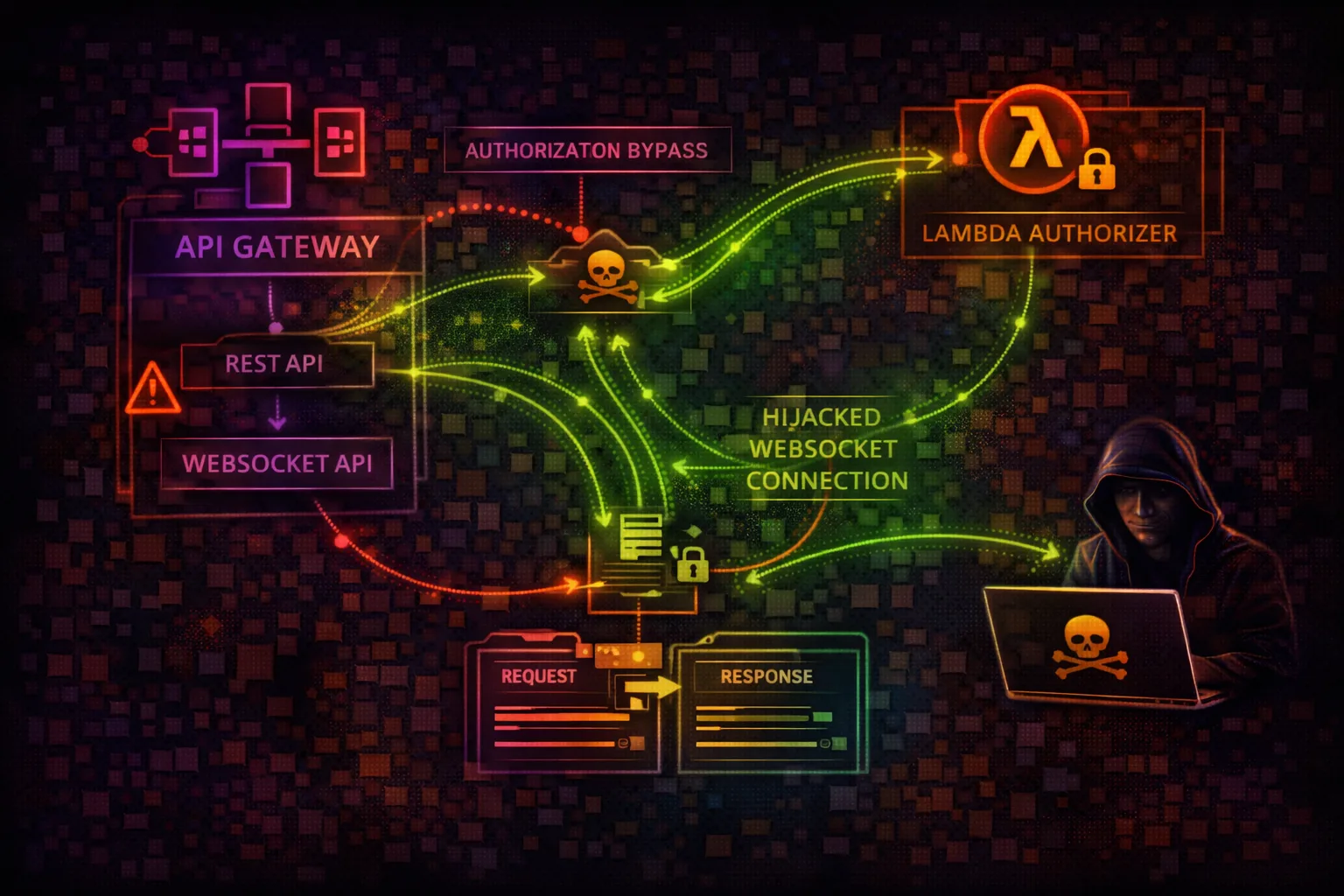

AWS API Gateway Security
APIAPI Gateway is the front door to AWS applications, proxying requests to Lambda, EC2, and other services. Attackers target misconfigured authorization, exposed endpoints, and information disclosure to access backend systems and exfiltrate data.
📋Service Overview
API Types & Architecture
API Gateway offers REST APIs (v1), HTTP APIs (v2), and WebSocket APIs. REST APIs provide the most features including VTL request/response transforms, resource policies, and caching. HTTP APIs are simpler and cheaper. WebSocket APIs maintain persistent connections.
Attack note: REST APIs with VTL mapping templates can be exploited for server-side template injection if user input reaches the template
Authorization Models
Endpoints can use NONE, IAM, Cognito, or Lambda authorizers. API keys are NOT authorization - they only control usage plans and rate limiting. Many developers mistakenly treat API keys as authentication, leaving endpoints effectively unprotected.
Attack note: Lambda authorizers with flawed logic (e.g., only checking token format, not signature) are a common bypass vector
Security Risk Assessment
API Gateway is often internet-facing by default, making misconfigurations directly exploitable. Missing or weak authorization allows unauthorized access to backend Lambda functions and services.
⚔️ Attack Vectors
Authorization Bypass
- •Missing authorization on endpoints (NONE)
- •Weak Lambda authorizer token validation
- •API key mistaken as authentication
- •Resource policy bypass via IP spoofing
- •Cognito pool misconfiguration
Injection & Abuse
- •VTL template injection in mapping
- •WebSocket message injection
- •CORS misconfiguration for credential theft
- •Stage variable injection
- •HTTP method override (GET vs POST)
⚠️ Misconfigurations
Authorization Issues
- •NONE authorization type on endpoints
- •Lambda authorizer returns wildcard policy
- •API keys without usage plans or throttling
- •Missing request validation
- •Authorizer caching with shared tokens
Exposure Issues
- •Overly permissive CORS (Origin: *)
- •Verbose error responses (stack traces)
- •Stage variables containing secrets
- •Dev/staging stages publicly accessible
- •WAF not attached to API
🔍 Enumeration
aws apigateway get-rest-apisaws apigatewayv2 get-apisaws apigateway get-resources \
--rest-api-id <api-id>aws apigateway get-method \
--rest-api-id <api-id> \
--resource-id <id> --http-method GETaws apigateway get-api-keys --include-values📈 Privilege Escalation
API-Level Escalation
- •Modify resource policy to allow attacker IP
- •Update authorizer to bypass authentication
- •Change integration to attacker Lambda
- •Promote dev stage config to production
- •Create new deployment with modified routes
Backend Pivoting
- •HTTP integration SSRF to internal services
- •VPC Link to access private resources
- •AWS Service integration for direct SDK calls
- •Lambda integration to RCE via function update
- •S3 integration to read arbitrary buckets
🔗 Persistence
API Backdoors
- •Add hidden endpoint with no auth
- •Create new stage with relaxed security
- •Modify Lambda authorizer to allow backdoor token
- •Add resource policy for attacker account
- •Deploy custom domain pointing to attacker API
WebSocket Persistence
- •Maintain persistent WebSocket connection
- •Inject route with attacker Lambda backend
- •Modify $connect authorizer for backdoor
- •Use WebSocket for C2 communication
- •Scheduled ping to keep connection alive
Tool reference: Use CloudFox to enumerate API Gateway configurations and find unprotected endpoints across multiple AWS accounts. Pacu module apigateway__enum maps all APIs and authorization types.
🛡️ Detection
CloudTrail Events
- •UpdateRestApi / UpdateApi
- •UpdateAuthorizer
- •CreateDeployment
- •GetApiKeys (credential enumeration)
Indicators of Compromise
- •New stages created (dev, test, backdoor)
- •Authorization type changed to NONE
- •Resource policy modifications
- •Unusual API call patterns in access logs
- •New integrations pointing to unknown Lambda/URLs
💻 Exploitation Commands
aws apigateway get-resources --rest-api-id <api-id> | \
  jq '.items[] | select(.resourceMethods) |
{path: .path, methods: (.resourceMethods | keys)}'aws apigateway get-method \
--rest-api-id <api-id> --resource-id <id> \
--http-method GET --query 'authorizationType'aws apigateway get-api-keys --include-values --query 'items[*].[name,value]'aws apigateway update-rest-api \
--rest-api-id <api-id> \
--patch-operations op=replace,path=/policy,value='{"Version":"2012-10-17","Statement":[{"Effect":"Allow","Principal":"*","Action":"execute-api:Invoke","Resource":"*"}]}'aws apigateway get-stages --rest-api-id <api-id>aws apigateway get-stage \
--rest-api-id <api-id> --stage-name dev \
--query 'variables'📜 Policy Examples
{
  "authorizationType": "NONE",
  "apiKeyRequired": false
}
// Anyone on the internet can call this endpoint
No authorization - anyone with the URL can invoke the API endpoint
{
  "authorizationType": "AWS_IAM",
  "apiKeyRequired": false
}
// Requires AWS SigV4 signed requests
Requires valid IAM credentials with execute-api:Invoke permission
{
  "Version": "2012-10-17",
  "Statement": [{
    "Effect": "Allow",
    "Principal": "*",
    "Action": "execute-api:Invoke",
    "Resource": "arn:aws:execute-api:*:*:*/*/*/*"
  }]
}
Allows any principal to invoke any method on any resource - no IP or VPC restrictions
{
  "Version": "2012-10-17",
  "Statement": [{
    "Effect": "Allow",
    "Principal": "*",
    "Action": "execute-api:Invoke",
    "Resource": "arn:aws:execute-api:*:*:*/prod/GET/*",
    "Condition": {
      "IpAddress": {"aws:SourceIp": "10.0.0.0/8"}
    }
  }]
}
Only allows GET requests from internal IP ranges on production stage
🛡️ Defense Recommendations
Always Use Authorization
Never deploy APIs with NONE authorization. Use IAM, Cognito, or Lambda authorizers.
Enable Access Logging
Log all API invocations to CloudWatch for security monitoring and forensics.
aws apigateway update-stage --rest-api-id <id> \
  --stage-name prod --patch-operations \
op=replace,path=/accessLogSettings/destinationArn,value=<log-group-arn>Restrict CORS Origins
Configure specific allowed origins. Never allow credentials with wildcard origin.
Access-Control-Allow-Origin: https://app.example.comResource Policies for IP/VPC
Implement IP restrictions or VPC-only access using resource policies.
"Condition": {"IpAddress": {
  "aws:SourceIp": ["10.0.0.0/8", "192.168.1.0/24"]
}}Enable Request Validation
Reject malformed requests before they reach backend integrations.
aws apigateway update-method \
  --rest-api-id <id> --resource-id <rid> \
  --http-method POST --patch-operations \
op=replace,path=/requestValidatorId,value=<validator-id>Attach AWS WAF
Protect against SQL injection, XSS, and rate limiting with WAF rules.
aws wafv2 associate-web-acl \
  --web-acl-arn <waf-arn> \
  --resource-arn arn:aws:apigateway:region::/restapis/<id>/stages/prod
AWS API Gateway Security Card • Toc Consulting
Always obtain proper authorization before testing
KloudSec, built by the team behind Toc Consulting
See API Gateway security checked automatically, continuously
What you just read is a manual, one-time check. KloudSec runs this and 400+ more automated checks across 90+ AWS services, continuously, agentless, live in about 5 minutes.
Toc Consulting: AWS Security & Cloud Architecture
Securing your AWS estate?
Our team helps engineering teams secure and architect AWS the right way: assessment in week one, a prioritized action plan in week two.